
|
You entered: time
 Comet Holmes in Outburst
26.10.2007
Comet 17P/Holmes stunned comet watchers across planet Earth earlier this week. On October 24, it increased in brightness over half a million times in a matter of hours. The outburst transformed it from...
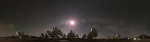 The View from Chajnantor
23.11.2011
From an altitude of over 5,000 meters, the night sky view from Chajnantor Plateau in the Chilean Andes is breathtaking in more ways than one. The dark site's rarefied atmosphere, at about 50 percent sea level pressure, is also extremely dry.
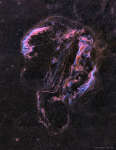 The Ghostly Veil Nebula
31.10.2019
A ghostly visage on a cosmic scale, these remains of shocked, glowing gas haunt planet Earth's sky toward the constellation of Cygnus and form the Veil Nebula. The nebula itself is a large supernova remnant, an expanding cloud born of the death explosion of a massive star.
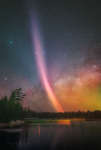 STEVE over Copper Harbor
5.05.2021
What creates STEVEs? Strong Thermal Emission Velocity Enhancements (STEVEs) have likely been seen since antiquity, but only in the past five years has it been realized that their colors and shapes make them different from auroras. Seen as single bright streaks of pink and purple, the origin of STEVEs remain an active topic of research.
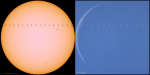 Sun and Moon and ISS
3.09.2022
On August 25 Sun and Moon could both be seen in planet Earth's daytime skies. And so could the International Space Station. The ISS crossed the disk of the waning crescent Moon as seen from Shunyi district, Beijing, China at about 11:02 am local time.
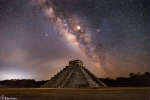 APOD: 2026 March 15 Б Equinox at the Pyramid of the Feathered Serpent
15.03.2026
To see the feathered serpent descend the Mayan pyramid requires exquisite timing. You must visit El Castillo -- in Mexico's Yucatцn Peninsula -- near an equinox. Then, during the late afternoon if the sky is clear, the pyramid's own shadows create triangles that merge into the famous illusion of a slithering viper.
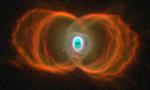 MyCn18: An Hourglass Nebula
4.06.2000
The sands of time are running out for the central star of this hourglass-shaped planetary nebula. With its nuclear fuel exhausted, this brief, spectacular, closing phase of a Sun-like star's life occurs as its outer layers are ejected - its core becoming a cooling, fading White Dwarf.
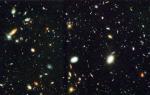 The Hubble Deep Field
9.07.2000
Galaxies like colorful pieces of candy fill the Hubble Deep Field - one of humanity's most distant optical views of the Universe. The dimmest, some as faint as 30th magnitude (about four billion times...
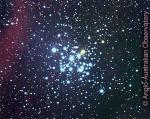 NGC 3293: A Bright Young Open Cluster
9.09.2001
Hot blue stars shine brightly in this beautiful, recently formed galactic or "open" star cluster. Open cluster NGC 3293 is located in the constellation Carina, lies at a distance of about 8000 light years, and has a particularly high abundance of these young bright stars.
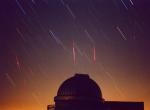 2001 Leonids: Meteors in Perspective
7.11.2002
The 2001 Leonid storm was so intense that the meteor shower's radiant, the point on the sky from which the fleeting trails seemed to diverge, was easy to spot. But the bits of debris that created the meteors really moved along parallel paths, following the orbit of their parent comet Tempel-Tuttle.
|
January February March April May June July August September |
|||||||||||||||||||||||||||||||||||||||||||||||||