
|
You entered: time
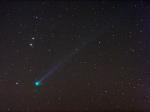 Unexpected Comet Pojmanski Now Visible
6.03.2006
Have you ever seen a comet? Comets bright enough to be visible to the unaided eye appear only every few years. Right now, however, a new comet has brightened unexpectedly and is visible as a faint streak to the unaided northern observer in the eastern morning sky just before sunrise. Binoculars may help.
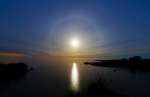 A Super Moon s Halo
28.06.2013
A Full Perigee Moon rose as the Sun set last Sunday. At its closest to Earth it was, by just a bit, the year's brightest and largest Full Moon also known as a Super Moon.
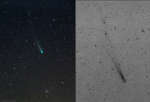 Active Comet ISON
16.11.2013
Falling through planet Earth's predawn skies toward its close encounter with the Sun on November 28, Comet ISON is coming to life. The much anticipated comet has now been reported to have substantially increased in brightness, surging to naked-eye visibility for dark sites and sprouting a more complex tail.
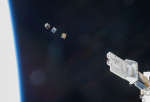 Three CubeSats Released
6.01.2014
Cubes are orbiting the Earth. Measuring ten-centimeters on a side, CubeSats -- each roughly the size of a large coffee mug -- are designed to be inexpensive both to build and to launch. Pictured above, three CubeSats were released from the International Space Station (ISS) last November by the arm of the Japanese Kibo Laboratory module.
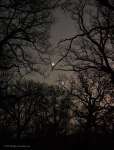 Mars Red and Spica Blue
2.04.2014
A bright pair of sky objects will be visible together during the next few months. Mars will shine brightly in its familiar rusty hue as it reaches its brightest of 2014 next week.
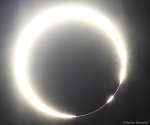 A Solar Eclipse with a Beaded Ring of Fire
1.03.2017
What kind of eclipse is this? On Sunday, visible in parts of Earth's southern hemisphere, the Moon blocked part of the Sun during a partial solar eclipse. In some locations, though, the effect was a rare type of partial eclipse called an annular eclipse.
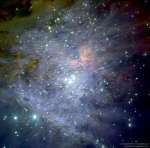 Magnetic Orion
27.02.2019
Can magnetism affect how stars form? Recent analysis of Orion data from the HAWC+ instrument on the airborne SOFIA observatory indicate that, at times, it can. HAWC+ is able to measure the polarization of far-infrared light which can reveal the alignment of dust grains by expansive ambient magnetic fields.
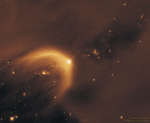 LDN 1471: A Windblown Star Cavity
6.05.2020
What is the cause of this unusual parabolic structure? This illuminated cavity, known as LDN 1471, was created by a newly forming star, seen as the bright source at the peak of the parabola.
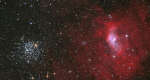 The Bubble and the Star Cluster
25.09.2021
To the eye, this cosmic composition nicely balances the Bubble Nebula at the right with open star cluster M52. The pair would be lopsided on other scales, though. Embedded in a complex of interstellar...
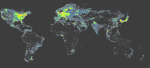 Artificial Night Sky Brightness
27.08.2001
Where have all the dim stars gone? From many places on the Earth including major cities, the night sky has been reduced from a fascinating display of hundreds of stars to a diffuse glow through which only a handful of stars are visible.
|
January February March April May June July August September |
|||||||||||||||||||||||||||||||||||||||||||||||||