
|
You entered: time
 Find the New Moon
25.07.2022
Can you find the Moon? This usually simple task can be quite difficult. Even though the Moon is above your horizon half of the time, its phase can be anything from crescent to full.
 Flying Over Asteroid Eros West End
17.04.2000
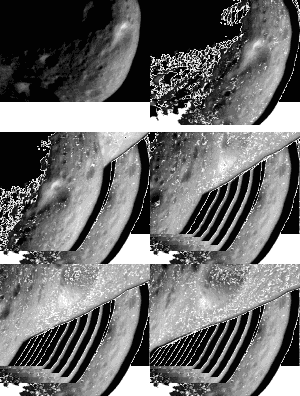
The robot spacecraft NEAR Shoemaker continues to orbit asteroid Eros. This condensed 40-minute long time-lapse sequence taken last month shows what it looks like to pass within 200 kilometers of Eros' west end. The north pole of the rotating mountain is toward the bottom of the picture.
 A Massive Cluster In A Young Universe
21.08.1998
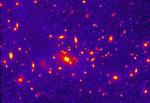
Conventional theories suggest that this cluster of galaxies should not exist. Each fuzzy spot in this false-color Hubble Space Telescope image of the central regions of a newly discovered galaxy cluster is a galaxy similar in mass to our own Milky Way.
 Hale-Bopp: The Crowd Pleaser Comet
9.07.1998
In 1997, the bright comet Hale-Bopp may have become the most viewed comet in history -- visible even to casual skywatchers in light polluted cities around the globe. In this picture, taken by photographer...
 In Chandor Chasma on Mars
31.05.2002
Scroll right and dive into a spectacular canyon on Mars. This daytime infrared view, recently recorded by the THEMIS camera on board the orbiting Mars Odyssey spacecraft, covers a 30 by 175 kilometer swath running along the canyon floor.
 A Glimpse of Titan's Surface
21.10.1995
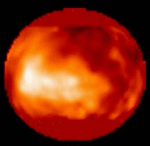
The surface of Titan, Saturn's largest moon, is normally hidden from view by its thick, hazy atmosphere. However, for the first time astronomers have been able to see surface features in images like the one above, made at near-infrared wavelengths with the Hubble Space Telescope.
 Betelgeuse, Betelgeuse, Betelgeuse
16.02.1997
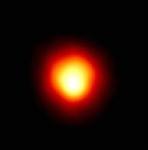
Betelgeuse (sounds a lot like "beetle juice"), a red supergiant star about 600 light years distant, is seen in this Hubble Space Telescope image -- the first direct picture of the surface of a star other than the Sun. A bright, as yet unexplained hotspot is revealed on its surface!
 Mars Simulated View
16.07.2003
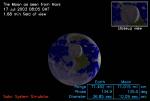
When earthdweller Patrick Vantuyne wondered what his home planet's single large moon would look like if viewed from Mars on July 17, he availed himself of the JPL Solar System Simulator. Of course...
 NGC 3293: A Bright Young Open Cluster
29.03.1998
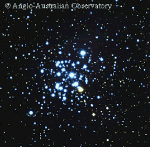
Hot blue stars shine brightly in this beautiful, recently formed galactic or "open" star cluster. Open cluster NGC 3293 is located in the constellation Carina, lies at a distance of about 8000 light years, and has a particularly high abundance of these young bright stars.
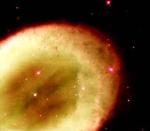 M57: The Ring Nebula
4.05.1998
It looked like a ring on the sky. Hundreds of years ago astronomers noticed a nebula with a most unusual shape. Now known as M57 or NGC 6720, the gas cloud became popularly known as the Ring Nebula.
|
January February March April May June July August September |
|||||||||||||||||||||||||||||||||||||||||||||||||