
|
You entered: time
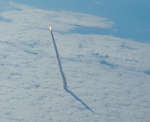 Space Shuttle Rising
15.04.2018
What's that rising from the clouds? The space shuttle. Sometimes, if you look out the window of an airplane at just the right time and place, you see something unusual -- in this case a space shuttle launching to orbit.
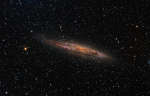 Nearby Spiral Galaxy NGC 4945
22.08.2019
Large spiral galaxy NGC 4945 is seen edge-on near the center of this cosmic galaxy portrait. In fact, it's almost the size of our Milky Way Galaxy. NGC 4945's own dusty disk, young blue star clusters, and pink star forming regions standout in the sharp, colorful telescopic image.
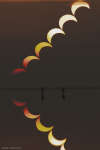 A Partial Solar Eclipse Sequence Reflected
27.12.2019
What's happened to the Sun? Yesterday, if you were in the right place at the right time, you could see the Sun rise partially eclipsed by the Moon. The unusual sight was captured...
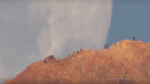 Moon Setting Behind Teide Volcano
22.03.2020
These people are not in danger. What is coming down from the left is just the Moon, far in the distance. Luna appears so large here because she is being photographed through a telescopic lens.
 Shakespeare in Space
29.12.2023
In 1986, Voyager 2 became the only spacecraft to explore ice giant planet Uranus close up. Still, this newly released image from the NIRCam (Near-Infrared Camera) on the James Webb Space Telescope offers a detailed look at the distant world. The tilted outer planet rotates on its axis once in about 17 hours.
 APOD: 2024 February 21 Б Seagull Nebula over Pinnacles Peak
21.02.2024
The bird is bigger than the peak. Nicknamed for its avian shape, the Seagull Nebula is an emission nebula on the night sky that is vast, spanning an angle over five times the diameter of the full moon and over 200 light years.
 Painting with Jupiter
19.04.2025
In digital brush strokes, Jupiter's signature atmospheric bands and vortices were used to form this interplanetary post-impressionist work of art. The creative image from citizen scientist Rick Lundh uses data from the Juno spacecraft's JunoCam.
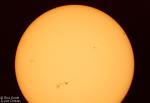 Spot The Planet
10.12.1999
OK, it's a picture of the Sun (duh!), but can you spot the planet? Of course, most of the spots you've spotted are sunspots, as large or larger than planet Earth itself.
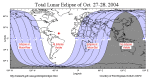 Total Lunar Eclipse Tonight
27.10.2004
Go outside tonight and see the total lunar eclipse. Tonight's eclipse is easy and convenient for much of the world to see. Anyone who can spot a full Moon -- even during the day -- can see it fade out as the Earth's shadow engulfs it.
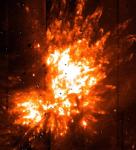 The Kleinmann Low Nebula
2.03.1999
The most active part of the Orion Nebular Cloud Complex is an area known as the Kleinmann-Low Nebula. There, a cluster of young and forming stars is embedded in a molecular cloud filled with dust.
|
January February March April May June July August September |
|||||||||||||||||||||||||||||||||||||||||||||||||