
|
You entered: star
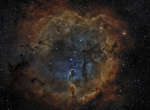 IC 1396: Emission Nebula in Cepheus
20.07.2017
Stunning emission nebula IC 1396 mixes glowing cosmic gas and dark dust clouds in the high and far off constellation of Cepheus. Energized by the bright central star seen here, this star forming region sprawls across hundreds of light-years, spanning over three degrees on the sky while nearly 3,000 light-years from planet Earth.
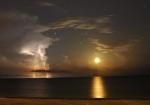 Moon Lightning
7.10.2004
Moonsets are not often quite as exciting as this one. But amateur astronomer Marc-Andre Besel was impressed by the brilliant lighting displays that joined the first quarter Moon and stars of the constellation Scorpius in western skies.
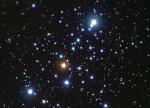 Distant Open Cluster M103
7.02.2001
Bright blue stars highlight the open cluster known as M103. The gas clouds from which these stars condensed has long dispersed. Of the stars that were formed, the brightest, bluest, and most massive have already used up their nuclear fuel and self-destructed in supernova explosions.
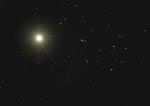 Venus and the Pleiades
15.04.2004
Venus still rules the western skies after sunset as the brilliant evening star. While wandering the ecliptic with its fellow naked-eye planets earlier this month, it passed near the Pleiades star cluster, providing a striking photo opportunity for earthbound skygazers.
 Planetary Nebula Mz3: The Ant Nebula
25.04.2010
Why isn't this ant a big sphere? Planetary nebula Mz3 is being cast off by a star similar to our Sun that is, surely, round. Why then would the gas that is streaming away create an ant-shaped nebula that is distinctly not round?
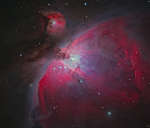 At the Heart of Orion
12.03.2017
Near the center of this sharp cosmic portrait, at the heart of the Orion Nebula, are four hot, massive stars known as the Trapezium. Tightly gathered within a region about 1.5 light-years in radius, they dominate the core of the dense Orion Nebula Star Cluster.
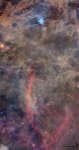 From the Pleiades to the Eridanus Loop
23.03.2020
If you stare at an interesting patch of sky long enough, will it look different? In the case of Pleiades and Hyades star clusters -- and surrounding regions -- the answer is: yes, pretty different. Long...
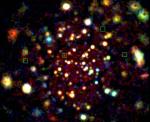 X-Ray Pleiades
18.03.1997
The Pleiades star cluster is one of the jewels of the northern sky. To the unaided eye it appears as a lovely and tantalizing grouping of stars in the constellation of Taurus, while telescopic views reveal cluster stars surrounded by delicate blue wisps of dust-reflected starlight.
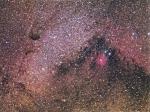 M24: A Sagittarius Starscape
21.09.2004
Many vast star fields in the plane of our Milky Way Galaxy are rich in clouds of dust, and gas. First and foremost, visible in the above picture are millions of stars, many of which are similar to our Sun.
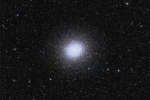 Omega Centauri: The Largest Globular Cluster Known
1.03.2009
This huge ball of stars predates our Sun. Long before humankind evolved, before dinosaurs roamed, and even before our Earth existed, ancient globs of stars condensed and orbited a young Milky Way Galaxy. Of the 200 or so globular clusters that survive today, Omega Centauri is the largest, containing over ten million stars.
|
January February March April May June July August September |
|||||||||||||||||||||||||||||||||||||||||||||||||