
|
You entered: star
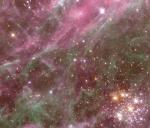 Denizen of the Tarantula Nebula
3.05.2003
The star cluster at lower right, cataloged as Hodge 301, is a denizen of the Tarantula Nebula. An evocative nebula in the southern sky, the sprawling cosmic Tarantula is an energetic star forming region some 168,000 light-years distant in our neighboring galaxy the Large Magellanic Cloud.
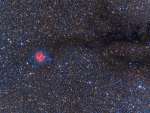 Cocoon Nebula Wide Field
29.09.2011
In this crowded starfield spanning some 3 degrees within the high flying constellation Cygnus, the eye is drawn to the Cocoon Nebula. A compact star forming region, the cosmic Cocoon punctuates a long trail of obscuring interstellar dust clouds.
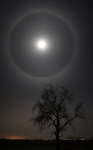 A February Moon Halo
11.02.2012
Lighting the night last Tuesday, February's Full Moon is sometimes called the Snow Moon. But the Moon was not quite full in this mosaicked skyscape recorded on February 2 south of Budapest, Hungary, and there was no snow either.
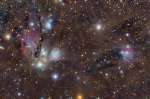 NGC 2170: Celestial Still Life
14.01.2013
In this celestial still life composed with a cosmic brush, dusty nebula NGC 2170 shines left of image center. Reflecting the light of nearby hot stars, NGC 2170 is joined by other bluish reflection nebulae, a red emission region, many dark absorption nebulae, and a backdrop of colorful stars.
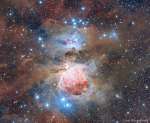 Dust of the Orion Nebula
28.12.2015
What surrounds a hotbed of star formation? In the case of the Orion Nebula -- dust. The entire Orion field, located about 1600 light years away, is inundated with intricate and picturesque filaments of dust.
 IC 2574: Coddington s Nebula
22.06.2012
Grand spiral galaxies often seem to get all the glory, flaunting their young, bright, blue star clusters in beautiful, symmetric spiral arms. But small, irregular galaxies form stars too. In fact dwarf galaxy IC 2574 shows clear evidence of intense star forming activity in its telltale pinkish regions of glowing hydrogen gas.
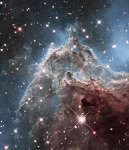 At the Edge of NGC 2174
3.04.2014
This fantastic skyscape lies near the edge of NGC 2174 a star forming region about 6,400 light-years away in the nebula-rich constellation of Orion. It follows mountainous clouds of gas and dust carved...
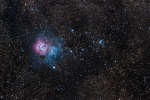 Messier 20 and 21
5.08.2020
The beautiful Trifid Nebula, also known as Messier 20, is easy to find with a small telescope in the nebula rich constellation Sagittarius. About 5,000 light-years away, the colorful study in cosmic contrasts shares this well-composed, nearly 1 degree wide field with open star cluster Messier 21 (right).
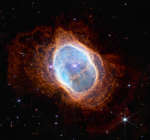 Webb s Southern Ring Nebula
13.07.2022
Cataloged as NGC 3132 the Southern Ring Nebula is a planetary nebula, the death shroud of a dying sun-like star some 2,500 light-years from Earth. Composed of gas and dust the stunning cosmic landscape is nearly half a light-year in diameter, explored in unprecedented detail by the James Webb Space Telescope.
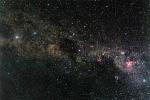 The Milky Way Near the Southern Cross
18.06.2000
This breathtaking patch of sky would be above you were you to stand at the South Pole of the Earth. Just above and to the right of this photograph's center are the four stars that mark the boundaries of the famous Southern Cross.
|
January February March April May June July August September |
|||||||||||||||||||||||||||||||||||||||||||||||||