
|
You entered: star
 A Filament in Monoceros
18.03.2022
Bluish reflection nebulae seem to fill this dusty expanse. The sharp telescopic frame spans over 1 degree on the sky toward the faint but fanciful constellation Monoceros, the Unicorn. Seen within the Monoceros...
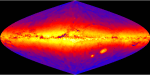 USNO A2.0 Catalog: A Digital Sky
26.04.1999
Here lie 526,230,881 of the brightest stars known. The US Naval Observatory has deployed their monster Precision Measuring Machine to digitize photographic plates covering the whole sky and creating the above map. Yellow corresponds to 150,000 stars per square degree, while dark blue corresponds to only 500 stars per square degree.
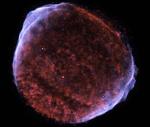 SN 1006: Supernova Remnant in X Rays
26.12.2005
This huge puff ball was once a star. One thousand years ago, in the year 1006, a new star was recorded in the sky that today we know was really an existing star exploding.
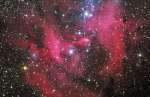 IC 2948: The Running Chicken Nebula
18.04.2008
Bright nebulae abound in and around the expansive southern constellation of Centaurus. This one, cataloged as IC 2948 is near the star Lambda Centauri and not far on the sky from the better known Eta Carinae Nebula.
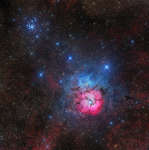 Messier 20 and 21
30.12.2019
The beautiful Trifid Nebula, also known as Messier 20, is easy to find with a small telescope in the nebula rich constellation Sagittarius. About 5,000 light-years away, the colorful study in cosmic contrasts shares this well-composed, nearly 1 degree wide field with open star cluster Messier 21 (top left).
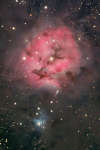 IC 5146: The Cocoon Nebula
27.08.2022
Inside the Cocoon Nebula is a newly developing cluster of stars. Cataloged as IC 5146, the beautiful nebula is nearly 15 light-years wide. Climbing high in northern summer night skies, it's located some 4,000 light years away toward the constellation Cygnus the Swan.
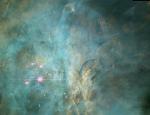 In the Center of the Trapezium
2.03.2003
Start with the constellation of Orion. Near Orion's belt is a fuzzy area known as the Great Nebula of Orion or M42. In this nebula is a bright star cluster known as the Trapezium, shown above. New stellar systems are forming there in gigantic globs of gas and dust known as Proplyds.
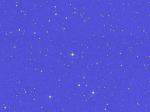 Gliese 581 and the Habitable Zone
26.04.2007
The faint, unremarkable star centered in this skyview is Gliese 581, a mere 20 light-years away toward the constellation Libra. But astronomers are now reporting the discovery of a remarkable system of three planets orbiting Gliese 581, including the most earth-like planet found beyond our solar system.
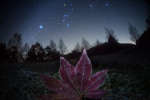 Frosted Leaf Orion
17.11.2010
Sometimes, you can put some night sky in your art. Captured above Japan earlier this month, a picturesque night sky was photographed behind a picturesque frosted leaf. The reflecting ice crystals on the leaf coolly mimic the shining stars far in the background.
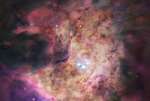 At the Heart of Orion
6.10.2012
Near the center of this sharp cosmic portrait, at the heart of the Orion Nebula, are four hot, massive stars known as the Trapezium. Gathered within a region about 1.5 light-years in radius, they dominate the core of the dense Orion Nebula Star Cluster.
|
January February March April May June July August September |
|||||||||||||||||||||||||||||||||||||||||||||||||