
|
You entered: star
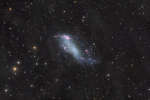 IC 2574: Coddington s Nebula
19.02.2026
Grand spiral galaxies often seem to get all the glory, flaunting their young, bright, blue star clusters in beautiful, symmetric spiral arms. But small, irregular galaxies form stars too. In fact, dwarf galaxy IC 2574 shows clear evidence of intense star forming activity in its telltale reddish regions of glowing hydrogen gas.
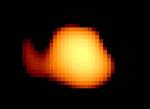 Resolving Mira
11.10.1998
Most stars appear only as points of light. Early last year, Betelgeuse became the second star, after our Sun, to have it surface resolved. Later last year, Mira was added to the list. Mira...
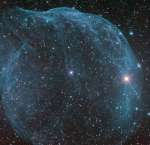 Sharpless 308
23.04.2009
Blown by fast winds from a hot, massive star, this cosmic bubble is huge. Cataloged as Sharpless 308 it lies some 5,200 light-years away in the constellation Canis Major and covers over 2/3 degree on the sky (compared with 1/2 degree for the Full Moon).
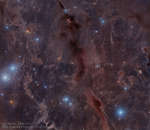 Dark Nebulas across Taurus
14.03.2016
Sometimes even the dark dust of interstellar space has a serene beauty. One such place occurs toward the constellation of Taurus. The filaments featured here can be found on the sky between the Pleiades star cluster and the California Nebula.
 Scintillating
28.04.2011
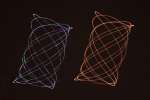
On June 4, 2010 Regulus, alpha star of the constellation Leo, and wandering planet Mars were at about the same apparent brightness, separated on the sky by 1.5 degrees. An ingenious and creative 10 second exposure from a swinging camera recorded these gyrating trails of the celestial pairing.
 The Summer Triangle Over Catalonia
10.08.2011
Can you find the Summer Triangle? It's not hard to find this famous triangle of stars this time of year from northern locations. Just look straight up after sunset and find three of the brightest stars in the sky that nearly form a triangle.
 The Dust Monster in IC 1396
2.08.2017
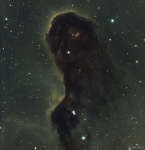
Is there a monster in IC 1396? Known to some as the Elephant's Trunk Nebula, parts of gas and dust clouds of this star formation region may appear to take on foreboding forms, some nearly human. The only real monster here, however, is a bright young star too far from Earth to hurt us.
 The Double Cluster in Perseus
7.07.2023
This pretty starfield spans about three full moons (1.5 degrees) across the heroic northern constellation of Perseus. It holds the famous pair of open star clusters, h and Chi Persei. Also cataloged...
 Messier 45: The Daughters of Atlas and Pleione
5.01.2023
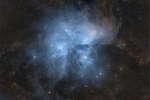
Hurtling through a cosmic dust cloud a mere 400 light-years away, the lovely Pleiades or Seven Sisters open star cluster is well-known for its striking blue reflection nebulae. It lies in the night sky toward the constellation Taurus and the Orion Arm of our Milky Way galaxy.
 The Andromeda Deep Field
19.05.2003
What can you learn from looking into the depths of space? In an effort to find out true ages of stars in neighboring Andromeda galaxy's halo, astronomers stared into the galaxy giant with the new Advanced Camera for Surveys through the Hubble Space Telescope.
|
January February March April May June July August September |
|||||||||||||||||||||||||||||||||||||||||||||||||