
|
You entered: orbit
 Artemis 1: Flight Day 13
30.11.2023
On flight day 13 (November 28, 2022) of the Artemis I mission, the Orion spacecraft reached its maximum distance from its home world. Over 430,000 kilometers from Earth in a distant retrograde orbit, Orion surpassed the record for most distant spacecraft designed to carry humans.
 APOD: 2024 November 10 Б Valles Marineris: The Grand Canyon of Mars
10.11.2024
The largest canyon in the Solar System cuts a wide swath across the face of Mars. Named Valles Marineris, the grand valley extends over 3,000 kilometers long, spans as much as 600 kilometers across, and delves as much as 8 kilometers deep.
 Saturn Rotates
3.10.2000
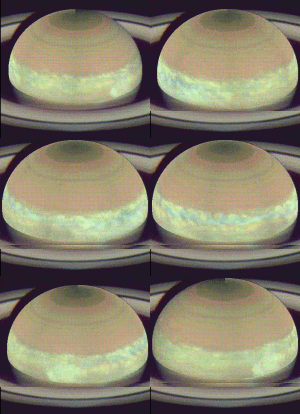
The dramatic rotation of the cloud-tops of Saturn every ten-hours is particularly evident from orbit around the gas giant planet. With a good enough telescope, however, such rotation is visible even from Earth, as shown by this time-lapse image sequence from the Hubble Space Telescope taken in November 1990.
 Stereo Saturn
29.10.1997
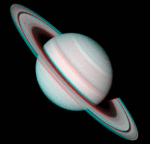
Get out your red/blue glasses and launch yourself into this stereo picture of Saturn! The picture is actually composed from two images recorded weeks apart by the Voyager 2 spacecraft during its visit to the Saturnian System in August of 1981.
 In the Center of the Keyhole Nebula
21.07.1997
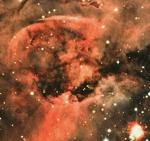
Stars, like people, do not always go gentle into that good night. The above Keyhole Nebula results from dying star Eta Carinae's violently casting off dust and gas during its final centuries. Eta Carinae is many times more massive than our own Sun, and should eventually undergo a tremendous supernova explosion.
 The Swirling Storms of Saturn
10.10.2005
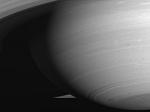
Storms larger than hurricanes continually dot the upper atmosphere of the planet Saturn. A view of many storms occurring simultaneously was captured in July by the robot Cassini spacecraft now orbiting Saturn. An image of unusually high detail was made possible at that time when Cassini isolated a very specific color of polarized infrared light.
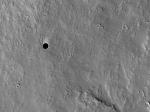 A Hole in Mars
28.05.2007
Black spots have been discovered on Mars that are so dark that nothing inside can be seen. Quite possibly, the spots are entrances to deep underground caves capable of protecting Martian life, where it to exist. The unusual hole pictured above was found on the slopes of the giant Martian volcano Arsia Mons.
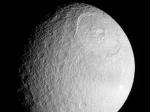 The Great Basin on Saturns Tethys
9.09.2007
Some moons wouldn't survive the collision. Tethys, one of Saturn's larger moons at about 1000 kilometers in diameter, survived the collision, but sports today the expansive impact crater Odysseus. Sometimes called...
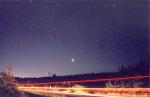 A July Dawn
7.08.2001
Those up before dawn in late July in the northern hemisphere could see planets, stars, and a spacecraft in a single quick glance before starting their day. Near the eastern horizon was bright Jupiter, and not far above and to its right was the very bright Venus.
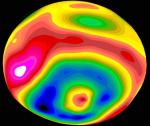 A Map of Asteroid Vesta
8.09.1997
Vesta is a huge rock 500 kilometers across that orbits out past Mars. Last week, the above map of Vesta created using the Hubble Space Telescope was released showing a rugged surface highlighted by a single crater spanning nearly the entire length of the asteroid.
|
January February March April May June July August September |
|||||||||||||||||||||||||||||||||||||||||||||||||