
|
You entered: orbit
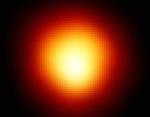 Betelgeuse
19.04.1998
Here is the first direct picture of the surface of a star other than our Sun. Taken by the Hubble Space Telescope in 1995, the atmosphere of Betelgeuse reveals some unexpected features, including a large bright hotspot visible below the center.
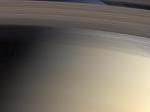 Seeing Through Saturns C Ring
20.09.2004
Are Saturn's rings transparent? The Cassini spacecraft that recently entered orbit around Saturn has confirmed that some of Saturn's rings are more transparent than others. Pictured above, Saturn's main A, B, and C rings can be seen, top to bottom, superposed against the gas giant planet.
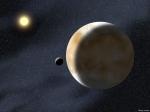 UB313: Larger than Pluto
7.02.2006
What do you call an outer Solar System object that is larger than Pluto? Nobody is yet sure. The question arose recently when 2003 UB313, an object currently twice as far out as Pluto and not in the plane with the rest of the planets, was verified recently to be 30 percent wider than Pluto.
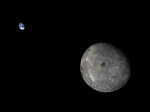 Moon and Earth from Chang e 5 T1
3.11.2014
Described at times as a big blue marble, from some vantage points Earth looks more like a small blue marble. Such was the case in this iconic image of the Earth and Moon system taken by the Chang'e 5-T1 mission last week.
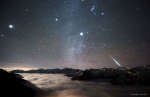 Geminid Fireball over Mount Balang
16.12.2014
This was a sky to remember. While viewing the Geminids meteor shower a few days ago, a bright fireball was captured over Mt. Balang, China with particularly picturesque surroundings. In the foreground, a sea of light clouds slowly floated between dark mountain peaks.
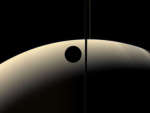 Crescent Rhea Occults Crescent Saturn
3.01.2015
Soft hues, partially lit orbs, a thin trace of the ring, and slight shadows highlight this understated view of the majestic surroundings of the giant planet Saturn. Looking nearly back toward the Sun, the robot Cassini spacecraft now orbiting Saturn captured crescent phases of Saturn and its moon Rhea in color a few years ago.
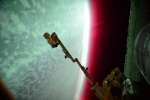 Planet Aurora
26.06.2015
What bizarre alien planet is this ? It's planet Earth of course, seen through the shimmering glow of aurorae from the International Space Station. About 400 kilometers (250 miles) above, the orbiting station is itself within the upper realm of the auroral displays, also watched from the planet's surface on June 23rd.
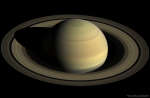 Saturn from Above
25.09.2016
This image of Saturn could not have been taken from Earth. No Earth based picture could possibly view the night side of Saturn and the corresponding shadow cast across Saturn's rings. Since Earth is much closer to the Sun than Saturn, only the day side of the ringed planet is visible from the Earth.
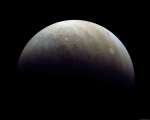 Southern Jupiter from Perijove 3
17.12.2016
Southern Jupiter looms some 37,000 kilometers away in this JunoCam image from December 11. The image data was captured near Juno's third perijove or closest approach to Jupiter, the spacecraft still in its 53 day long looping orbit.
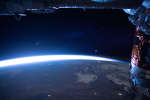 Comet NEOWISE from the ISS
10.07.2020
Rounding the Sun on July 3rd and currently headed for the outer Solar System, Comet NEOWISE (C/2020 F3) has been growing brighter in the predawn skies of planet Earth. From low Earth orbit...
|
January February March April May June July August September |
|||||||||||||||||||||||||||||||||||||||||||||||||