
|
You entered: orbit
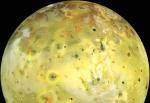 Io in True Color
15.07.2001
The strangest moon in the Solar System is bright yellow. This picture, showing Io's true colors, was taken in 1999 July by the Galileo spacecraft currently orbiting Jupiter. Io's colors derive from sulfur and molten silicate rock. The unusual surface of Io is kept very young by its system of active volcanoes.
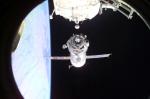 Leaving the International Space Station
17.12.2001
It was time to go home. During their eight days aboard the Earth-orbiting International Space Station (ISS), ESA Flight Engineer Claudie Haigner, Russian Commander Victor Afanasyev, and Russian Flight Engineer Konstantin Kozeev had completed several experiments and successfully delivered a new lifeboat.
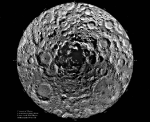 Shadow at the Lunar South Pole
28.11.1995
In 1994, the space probe Clementine spent 70 days in lunar orbit mapping the Moon's surface. Shown above is a dramatically detailed composite view centered on the Moon's South Pole constructed from 1500 Clementine images.
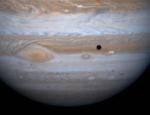 Jupiter, Io, and Shadow
7.12.2002
Pictured above is the innermost of Jupiter's Galilean satellites, Io, superposed in front of the gas giant planet. To the left of Io is a dark spot that is Io's own shadow. A solar eclipse would be seen from within the shadow spot on Jupiter.
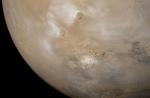 The Fogs of Mars
2.06.2003
Fogs of clouds and dust covered parts of southern Mars during last Martian winter. Giant volcanoes, such as Ascraeus Mons, the central circular feature near the top of the image, were surrounded by large water clouds. Slightly southwest, Pavonis Mons and Arisa Mons also peeked above their water clouds.
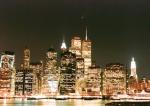 Comet Hale-Bopp Over New York City
8.04.1997
What's that point of light above the World Trade Center? It's Comet Hale-Bopp! Both faster than a speeding bullet and able to "leap" tall buildings in its single orbit, Comet Hale-Bopp is also bright enough to be seen even over the glowing lights of one of the world's premier cities.
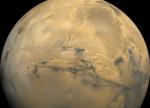 Valles Marineris: The Grand Canyon of Mars
24.08.2003
The largest canyon in the Solar System cuts a wide swath across the face of Mars. Named Valles Marineris, the grand valley extends over 3,000 kilometers long, spans as much as 600 kilometers across, and delves as much as 8 kilometers deep.
 The Face on Mars
22.07.1995
This image, showing what looks to be a human face sculpted on the martian surface, was produced using data from NASA's Viking 1 orbiter in 1976. Described in a press release...
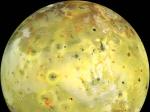 Io in True Color
2.05.2004
The strangest moon in the Solar System is bright yellow. This picture, showing Io's true colors, was taken in 1999 July by the Galileo spacecraft that orbited Jupiter from 1995 to 2003. Io's colors derive from sulfur and molten silicate rock.
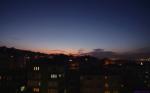 Venus Just After Sunset
1.02.2006
Is that Venus or an airplane? A common ponderable for sky enthusiasts is deciding if that bright spot near the horizon is the planet Venus. Usually, an airplane will show itself by moving significantly in a few moments. Venus will set only slowly as the Earth turns.
|
January February March April May June July August September |
|||||||||||||||||||||||||||||||||||||||||||||||||