
|
You entered: nebula
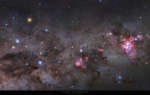 Southern Cross to Eta Carinae
25.04.2019
Tracking along the southern Milky Way this beautiful celestial mosaic was recorded under dark Brazilian skies. Spanning some 20 degrees it actually starts with the dark expanse of the Coalsack nebula at the lower left, tucked under an arm of the Southern Cross.
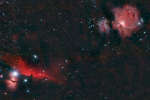 Horsehead and Orion Nebulae
9.03.2009
Adrift 1,500 light-years away in one of the night sky's most recognizable constellations, the glowing Orion Nebula and the dark Horsehead Nebula are contrasting cosmic vistas. They appear in opposite corners of this stunning mosaic taken with a digital camera attached to a small telescope.
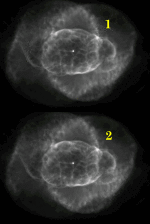 The Incredible Expanding Cats Eye
16.09.1999
Watch closely. As this animation blinks between two Hubble Space Telescope images of NGC 6543 - the first from 1994 and the second from 1997 - the intricate filaments of this nebula are seen to shift. The shift is due to the actual expansion of this gaseous shroud shed by a dying star!
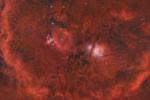 Orion s Cradle
24.01.2007
Cradled in glowing hydrogen, stellar nurseries in Orion lie at the edge of a giant molecular cloud some 1,500 light-years away. This breath-taking view spans about 13 degrees across the center of the well-known constellation with the Great Orion Nebula, the closest large star forming region, just right of center.
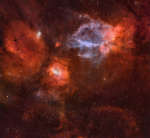 NGC 7635: Bubble in a Cosmic Sea
25.10.2017
Adrift in a cosmic sea of stars and glowing gas the delicate, floating apparition left of center in this widefield view is cataloged as NGC 7635, the Bubble Nebula. A mere 10 light-years wide, the tiny Bubble Nebula was blown by the winds of a massive star.
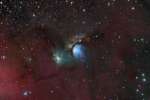 M78 Wide Field
25.11.2009
Interstellar dust clouds and glowing nebulae abound in the fertile constellation of Orion. One of the brightest, M78, is centered in this colorful, wide field view, covering an area north of Orion's belt. At a distance of about 1,500 light-years, the bluish reflection nebula is around 5 light-years across.
 A Cosmic Rose: NGC 2237 in Monoceros
13.02.2025
The Rosette Nebula, NGC 2237, is not the only cosmic cloud of gas and dust to evoke the imagery of flowers, but it is probably the most famous. At the edge of a large molecular cloud in Monoceros some 5,000 light years away, the petals of this cosmic rose are actually a stellar nursery.
 Sagittarius and the Central Milky Way
5.06.1996
What does the center of our Milky Way Galaxy look like? No one knows! It is not possible to see the Galactic center in light our eyes are sensitive to because the thick dust in the plane of our Galaxy obscures it.
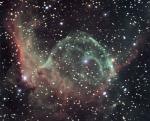 NGC 2359: Thor s Helmet
4.12.2002
NGC 2359 is a striking emission nebula with an impressive popular name - Thor's Helmet. Sure, its suggestive winged appearance might lead some to refer to it as the "duck nebula", but if you were a nebula which name would you choose?
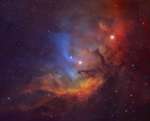 The Tulip in the Swan
26.07.2012
Framing a bright emission region this telescopic view looks out along the plane of our Milky Way Galaxy toward the nebula rich constellation Cygnus the Swan. Popularly called the Tulip Nebula the glowing cloud of interstellar gas and dust is also found in the 1959 catalog by astronomer Stewart Sharpless as Sh2-101.
|
January February March April May |
|||||||||||||||||||||||||||||||||||||||||||||||||