
|
You entered: nebula
 A Dark Seahorse in Cepheus
6.11.2025
Spanning light-years, this suggestive shape known as the Seahorse Nebula floats in silhouette against a rich background of stars and glowing hydrogen gas. Seen toward the royal northern constellation of Cepheus, the dusty, dark nebula is part of a Milky Way molecular cloud some 1,200 light-years distant.
 APOD: 2025 February 11 Б The Spider and the Fly
10.02.2025
Will the spider ever catch the fly? Not if both are large emission nebulas toward the constellation of the Charioteer (Auriga). The spider-shaped gas cloud in the image center is actually an emission nebula...
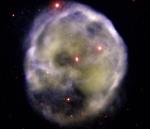 NGC 246 and the Dying Star
18.04.2006
Appropriately nicknamed "the Skull Nebula", planetary nebula NGC 246 really does surround a dying star some 1,600 light-years away in the constellation Cetus. Expelled over a period of thousands of years, the lovely, intricate nebula is the outer atmosphere of a once sun-like star.
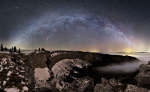 Milky Way Over Switzerland
20.02.2011
What's visible in the night sky during this time of year? To help illustrate the answer, a beautiful land, cloud, and skyscape was captured earlier this month over NeuchБtel, Switzerland. Visible in the foreground were the snow covered cliffs of the amphitheater shaped Creux du Van, as well as distant trees, and town-lit clouds.
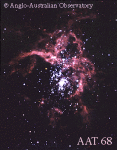 The Violent Star Cluster 30 Doradus
23.05.1996
The largest, most violent star forming region known in the whole Local Group of galaxies lies in our neighboring galaxy the LMC. Were 30 Doradus at the distance of the Orion Nebula -- a local star forming region -- it would take up fully half the sky.
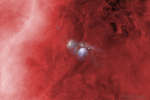 APOD: 2026 January 28 Б M78: Reflecting Blue in a Sea of Red
27.01.2026
In the vast Orion Molecular Cloud complex, several bright blue nebulas are particularly apparent. Pictured here in the center are two of the most prominent reflection nebulas - dust clouds lit by the reflecting light of bright embedded stars. The more famous nebula is M78, in the image center, cataloged over 200 years ago.
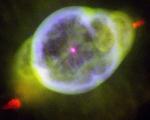 NGC 3242: The Ghost of Jupiter
29.10.2005
After a star like the Sun completes fusion in its core, it throws off its outer layers in a brief, beautiful cosmic display called a planetary nebula. NGC 3242 is such a planetary nebula, with the stellar remnant white dwarf star visible at the center.
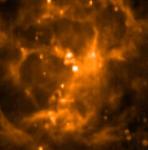 Infrared Trifid
28.08.1997
The Trifid nebula (M20) is a bright star forming region in Sagittarius, 5000 light years from Earth. In visible light, the interstellar gas cloud is crossed by dark, obscuring dust lanes which roughly divide the glowing emission nebula into three major parts.
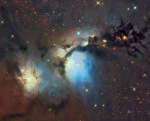 M78 and Reflecting Dust Clouds in Orion
1.03.2010
An eerie blue glow and ominous columns of dark dust highlight M78 and other bright reflection nebula in the constellation of Orion. The dark filamentary dust not only absorbs light, but also reflects the light of several bright blue stars that formed recently in the nebula.
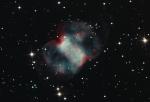 Messier 76
1.11.2006
"Nebula at the right foot of Andromeda ... " begins the description for the 76th object in Charles Messier's 18th century Catalog of Nebulae and Star Clusters. In fact, M76 is one of the fainter objects on the Messier list and is also known by the popular name of the "Little Dumbbell Nebula".
|
January February March April May |
|||||||||||||||||||||||||||||||||||||||||||||||||