
|
You entered: nebula
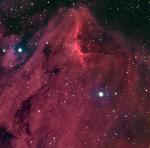 The Pelican in the Swan
29.08.2002
The Pelican Nebula, also known as IC 5070, lies about 2,000 light-years away in the high and far-off constellation of Cygnus, the Swan. This picture spans a portion of the magnificent nebula about 30 light-years wide.
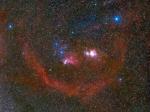 Barnards Loop Around Orion
20.04.2005
Why is the belt of Orion surrounded by a bubble? Although glowing like an emission nebula, the origin of the bubble, known as Barnard's Loop, is currently unknown. Progenitor hypotheses include the winds from bright Orion stars and the supernovas of stars long gone.
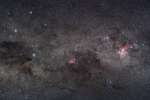 The Southern Cross in a Southern Sky
7.07.2008
This breathtaking patch of sky would be above you were you to stand at the South Pole of the Earth. On the upper left of this image are the four stars that mark the boundaries of the famous Southern Cross.
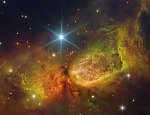 Star Forming Region S106
7.11.2011
Massive star IRS 4 is beginning to spread its wings. Born only about 100,000 years ago, material streaming out from this newborn star has formed the nebula dubbed Sharpless 2-106 Nebula (S106), pictured above.
 When Roses Aren t Red
9.02.2024
Not all roses are red of course, but they can still be very pretty. Likewise, the beautiful Rosette Nebula and other star forming regions are often shown in astronomical images with a predominately red hue, in part because the dominant emission in the nebula is from hydrogen atoms.
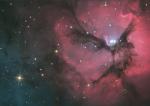 A Beautiful Trifid
1.09.2003
The beautiful Trifid Nebula (aka M20), a photogenic study in cosmic contrasts, lies about 5,000 light-years away toward the nebula rich constellation Sagittarius. A star forming region in the plane of our galaxy...
 A Close-Up of the Lagoon's Hourglass
21.08.1996
In the central part of the Lagoon Nebula lies the above pictured Hourglass Nebula. In this region of recent star formation, obscuring dark lanes of dust permeate the red-glowing hydrogen gas. Blocking some...
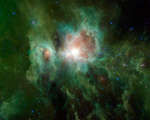 Infrared Orion from WISE
13.02.2013
The Great Nebula in Orion is a intriguing place. Visible to the unaided eye, it appears as a small fuzzy patch in the constellation of Orion. But this image, an illusory-color composite of four...
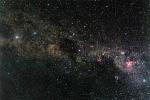 The Milky Way Near the Southern Cross
18.06.2000
This breathtaking patch of sky would be above you were you to stand at the South Pole of the Earth. Just above and to the right of this photograph's center are the four stars that mark the boundaries of the famous Southern Cross.
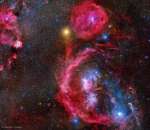 A 212 Hour Exposure of Orion
29.03.2020
The constellation of Orion is much more than three stars in a row. It is a direction in space that is rich with impressive nebulas. To better appreciate this well-known swath of sky, an extremely long exposure was taken over many clear nights in 2013 and 2014.
|
January February March April May |
|||||||||||||||||||||||||||||||||||||||||||||||||