
|
You entered: time
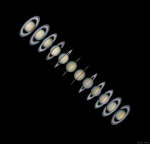 Rings and Seasons of Saturn
19.09.2021
On Saturn, the rings tell you the season. On Earth, Wednesday marks an equinox, the time when the Earth's equator tilts directly toward the Sun. Since Saturn's grand rings orbit along...
 APOD: 2024 August 27 Б Moon Eclipses Saturn
27.08.2024
What if Saturn disappeared? Sometimes, it does. It doesn't really go away, though, it just disappears from view when our Moon moves in front. Such a Saturnian eclipse, more formally called an occultation, was visible along a long swath of Earth -- from Peru, across the Atlantic Ocean, to Italy -- only a few days ago.
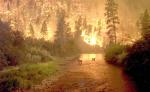 Fire on Earth
21.11.2000
Sometimes, regions of planet Earth can be seen lit up with fire. Since fire is the rapid acquisition of oxygen, and since oxygen is a key indicator of life, fire on any planet would be an indicator of life on that planet.
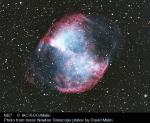 M27: The Dumbbell Nebula
18.02.1998
The first hint of what will become of our Sun was discovered inadvertently in 1764. At that time, Charles Messier was compiling a list of "annoying" diffuse objects not to be confused with "interesting" comets.
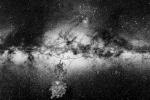 Sagittarius Dwarf to Collide with Milky Way
16.02.1998
Our Galaxy is being invaded. Recent observations indicate that in the next 100 million years, the Sagittarius Dwarf galaxy will move though the disk of our own Milky Way Galaxy yet again . The Sagittarius...
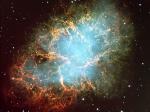 The Crab Nebula from VLT
25.03.2001
The Crab Nebula, filled with mysterious filaments, is the result of a star that was seen to explode in 1054 AD. This spectacular supernova explosion was recorded by Chinese and (quite probably) Anasazi Indian astronomers.
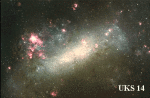 The Large Cloud of Magellan
18.09.1995
Magellan and his crew had plenty of time to study the southern sky during their famous voyage around the world. As a result, two fuzzy cloud like objects, nestled among the southern constellations of Doradus and Tucana are now known as the Clouds of Magellan.
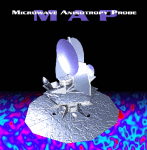 NASA Mission to MAP the Universe
15.04.1996
What is our universe made of? How rapidly is our universe expanding? When did galaxies form? These questions, among the most important and baffling to astronomers since the beginning of the modern astronomical era, might well be answered by a new space satellite mission.
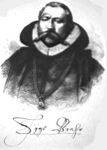 Tycho Brahe Measures the Sky
15.09.1996
Tycho Brahe was the most meticulous astronomical observer of his time. Brahe, who lived between 1546 and 1601, set out to solve the day's most pressing astronomical problem: to determine whether the Earth or the Sun was at the center of the Solar System.
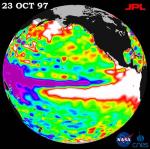 El Nino Earth
12.11.1997
El Niño is a temporary global climate change resulting from unusually warm water in the central Pacific Ocean. El Niño can cause unusual or severe weather for some locations over the next few months.
|
January February March April May June July August September |
|||||||||||||||||||||||||||||||||||||||||||||||||