
|
You entered: time
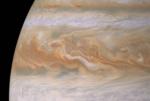 Jupiter Portrait
14.11.2003
Every day is a cloudy day on Jupiter, the Solar System's reigning gas giant. And swirling cloud tops are all you see in this stunningly detailed true color image, a portion of a large digital mosaic portrait of Jupiter recorded from the Cassini spacecraft during its Jovian flyby in December 2000.
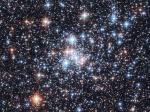 Open Cluster NGC 290: A Stellar Jewel Box
1.05.2006
Jewels don't shine this bright -- only stars do. Like gems in a jewel box, though, the stars of open cluster NGC 290 glitter in a beautiful display of brightness and color. The photogenic cluster, pictured above, was captured recently by the orbiting Hubble Space Telescope.
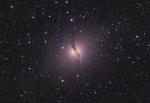 Jumbled Galaxy Centaurus A
30.06.2007
At the center of this sharp skyscape, Centaurus A seems to be a fantastic jumble of old yellow stars, young blue star clusters, and imposing dark dust lanes. Spanning over 60,000 light-years, the peculiar elliptical galaxy is apparently the result of a collision of two otherwise normal galaxies.
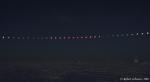 South Pole Lunar Eclipse
7.09.2007
The Moon was up continuously for 14 days in August -- when viewed from the South Pole. But during the total lunar eclipse on August 28, it circled only about 10 degrees above the horizon.
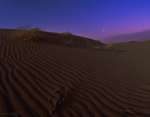 Brighter Than Mars
27.08.2010
Even though you may have just read an email claiming Mars will be incredibly bright tonight, the brightest star on the horizon is not Mars. From central Iran on August 24th, the brightest star in this twilight desert skyview is Venus, aka the Evening Star.
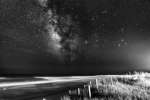 Shoreline of the Universe
20.09.2014
Against dark rifts of interstellar dust, the ebb and flow of starlight along the Milky Way looks like waves breaking on a cosmic shore in this night skyscape. Taken with a digital camera from...
 A Night at Poker Flat
29.01.2015
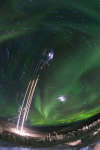
Four NASA suborbital sounding rockets leapt into the night on January 26, from the University of Alaska's Poker Flat Research Range. This time lapse composite image follows all four launches of the small, multi-stage rockets to explore winter's mesmerizing, aurora-filled skies.
 Highlights of the North Autumn Sky
25.09.2018
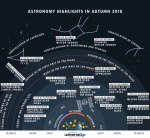
What can you see in the night sky this season? The featured graphic gives a few highlights for Earth's northern hemisphere. Viewed as a clock face centered at the bottom, early (northern) autumn sky events fan out toward the left, while late autumn events are projected toward the right.
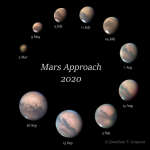 Mars Approach 2020
6.10.2020
Look to the east just after sunset tonight and you'll see a most impressive Mars. Tonight, Mars will appear its biggest and brightest of the year, as Earth passes closer to the red planet than it has in over two years -- and will be again for another two years.
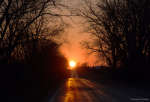 A Picturesque Equinox Sunset
20.03.2022
What's that at the end of the road? The Sun. Many towns have roads that run east - west, and on two days each year, the Sun rises and sets right down the middle. Today is one of those days: an equinox.
|
January February March April May June July August September |
|||||||||||||||||||||||||||||||||||||||||||||||||