
|
You entered: time
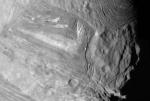 Miranda
19.02.1998
Miranda is a bizarre world which surely had a tempestuous past. The innermost of the larger Uranian moons, Miranda is almost 300 miles in diameter and was discovered only 50 years ago (February 16, 1948) by the renown American planetary astronomer Gerard Kuiper.
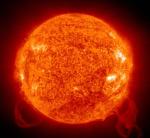 Double Eruptive Prominences
18.04.2003
Lofted over the Sun on looping magnetic fields, large solar prominences are composed of relatively cool, dense plasma. When seen against the brilliant solar disk they appear as dark filaments, but these enormous magnetic...
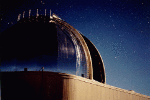 IRTF: Scanning the Infrared Skies
4.09.1996
Above, NASA's Infrared Telescope Facility (IRTF) poses in front of a starry background. Located on top of Hawaii's towering volcano Mauna Kea, the IRTF is the premier telescope for observing in near infrared light. This 3-meter telescope was established in 1979 and spends about half its time observing Solar System objects.
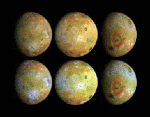 Three Views of Jupiter's Io
3.10.1996
The Galileo spacecraft orbiting Jupiter continues to return impressive results. The Galileo team has just released three more photographs of Jupiter's volcanic moon Io taken in June. These three photos are reflected at the bottom of the above picture, digitally enhanced to better show important features.
 Sparkling Star May Indicate Galactic Composition
24.06.1998
If a star in this photograph twinkled slightly, would anyone notice? Would anyone care? Astronomers with the MACHO Collaboration noticed one such twinkle just last week, and many members of the astronomical community now care.
 A Planet For Gliese 876
26.06.1998
Centered in this unremarkable, 1/4 degree wide patch of sky in the constellation Aquarius is the star Gliese 876. Gliese 876 is smaller than the Sun, only about 1/3 as massive, and too faint to be seen without a telescope. But it is known to be one of the nearest stars, only 15 light-years distant.
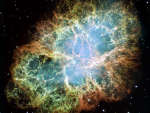 M1: The Crab Nebula from Hubble
17.02.2008
This is the mess that is left when a star explodes. The Crab Nebula, the result of a supernova seen in 1054 AD, is filled with mysterious filaments. The filaments are not only tremendously...
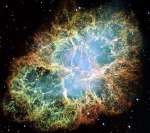 M1: The Crab Nebula from Hubble
25.10.2009
This is the mess that is left when a star explodes. The Crab Nebula, the result of a supernova seen in 1054 AD, is filled with mysterious filaments. The filaments are not only tremendously...
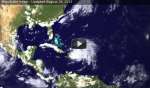 Hurricane Irene Forms
27.08.2011
How does a hurricane form? Although a complete picture is still being researched, insight into this process might be gleaned by watching the above time lapse movie of the formation of Hurricane Irene, a large storm system currently threatening the eastern seaboard of the USA.
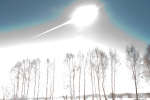 Chelyabinsk Meteor Flash
23.02.2013
A meteoroid fell to Earth on February 15, streaking some 20 to 30 kilometers above the city of Chelyabinsk, Russia at 9:20am local time. Initially traveling at about 20 kilometers per second, its explosive deceleration after impact with the lower atmosphere created a flash brighter than the Sun.
|
January February March April May June July August September |
|||||||||||||||||||||||||||||||||||||||||||||||||