
|
You entered: time
 Venus, Jupiter, and Noctilucent Clouds
1.07.2015
Have you seen the passing planets yet? Today the planets Jupiter and Venus pass within half a degree of each other as seen from Earth. This conjunction, visible all over the world, is quite easy to see -- just look to the west shortly after sunset.
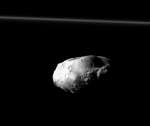 Prometheus and the F Ring
8.01.2016
In Greek myth Prometheus was a Titan, known for bringing fire from Mount Olympus. But in modern times the name is given to is a small moon of Saturn, orbiting just inside Saturn's F ring.
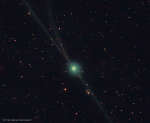 Almost Three Tails for Comet Encke
20.02.2017
How can a comet have three tails? Normally, a comet has two tails: an ion tail of charged particles emitted by the comet and pushed out by the wind from...
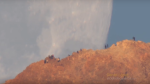 Moon Setting Behind Teide Volcano
4.06.2018
These people are not in danger. What is coming down from the left is just the Moon, far in the distance. Luna appears so large here because she is being photographed through a telescopic lens.
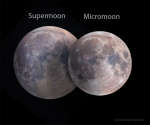 APOD: 2026 May 30 Б Supermoon Versus Micromoon
30.05.2026
What is so micro about tonight's blue micromoon? Just after sunset, a full moon will appear slightly smaller and dimmer than usual. The reason is that the Moon's fully illuminated phase occurs within a short time of apogee - when the Moon is farthest from the Earth in its elliptical orbit.
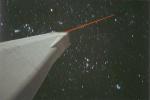 Space Laser Creates Artificial Star
25.04.2001
Some astronomers don't like stars. Bright star fluctuations can indicate how the Earth's atmosphere is changing, but many times no bright star exists in the direction where atmospheric information is needed.
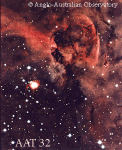 The Keyhole Nebula Near Eta Carinae
4.04.1996
The dark dusty Keyhole Nebula gets its name from its unusual shape. Designated NGC 3324, the Keyhole Nebula is a smaller region superposed on the bright Eta Carina Nebula. The Eta Carina Nebula...
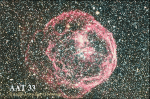 Henize 70: A SuperBubble In The LMC
10.05.1996
Massive stars (tens of times the mass of the Sun) profoundly affect their galactic environment. Churning and mixing the clouds of gas and dust between the stars, they leave their mark in the compositions and locations of future generations of stars and star systems.
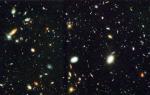 The Hubble Deep Field
1.09.2002
Galaxies like colorful pieces of candy fill the Hubble Deep Field - one of humanity's most distant optical views of the Universe. The dimmest, some as faint as 30th magnitude (about four billion times...
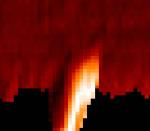 Tornadoes on the Sun
29.04.1998
Giant spinning clouds of gas, similar to Earth's tornadoes, have been found on the Sun. Solar tornadoes, however, can be larger than the entire Earth, and sustain wind gusts over 1000 times stronger than their Earth counterparts.
|
January February March April May June July August September |
|||||||||||||||||||||||||||||||||||||||||||||||||