
|
You entered: dust
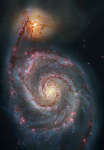 M51 Hubble Remix
26.12.2009
The 51st entry in Charles Messier's famous catalog is perhaps the original spiral nebula - a large galaxy with a well defined spiral structure also cataloged as NGC 5194. Over 60,000 light-years across, M51's spiral arms and dust lanes clearly sweep in front of its companion galaxy (right), NGC 5195.
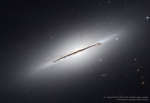 Edge On Galaxy NGC 5866
9.03.2016
Why is this galaxy so thin? Many disk galaxies are actually just as thin as NGC 5866, pictured above, but are not seen edge-on from our vantage point. One galaxy that is situated edge-on is our own Milky Way Galaxy.
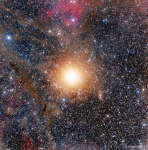 Behind Betelgeuse
11.05.2020
What's behind Betelgeuse? One of the brighter and more unusual stars in the sky, the red supergiant star Betelgeuse can be found in the direction of famous constellation Orion. Betelgeuse, however, is actually...
 APOD: 2024 January 1 Б NGC 1232: A Grand Design Spiral Galaxy
1.01.2024
Galaxies are fascinating not only for what is visible, but for what is invisible. Grand spiral galaxy NGC 1232, captured in detail by one of the Very Large Telescopes, is a good example.
 Ancient Volcanos of Mars
8.08.2002
Findings of ancient martian microbial fossils in meteorites and liquid water related features on Mars' surface are currently controversial issues. But one thing long established by space-based observations of the Red Planet is the presence of volcanos, as Mars supports some of the largest volcanos in the solar system.
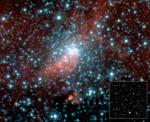 Glimpse of a Globular Star Cluster
14.10.2004
Not a glimpse of this cluster of stars can be seen in the inset visible light image (lower right). Still, the infrared view from the Spitzer Space Telescope reveals a massive globular star cluster of about 300,000 suns in an apparently empty region of sky in the constellation Aquila.
 Supernova Remnant Puppis A
12.09.2014
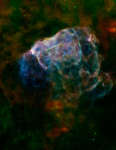
Driven by the explosion of a massive star, supernova remnant Puppis A is blasting into the surrounding interstellar medium about 7,000 light-years away. At that distance, this remarkable false-color exploration of its complex expansion is about 180 light-years wide.
 Dueling Bands in the Night
27.02.2018
What are these two bands in the sky? The more commonly seen band is the one on the right and is the central band of our Milky Way galaxy. Our Sun orbits...
 Massive Stars of 30 Doradus
22.06.2003
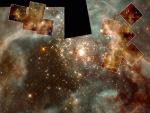
In the center of star-forming region 30 Doradus lies a huge cluster of the largest, hottest, most massive stars known. These stars and part of the surrounding nebula are captured here in this gorgeous visible-light Hubble Space Telescope image.
 Edge On Galaxy NGC 5866
12.06.2006
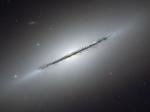
Why is this galaxy so thin? Many disk galaxies are actually just as thin as NGC 5866, pictured above, but are not seen edge-on from our vantage point. One galaxy that is situated edge-on is our own Milky Way Galaxy.
|
January February March April May June July August September |
|||||||||||||||||||||||||||||||||||||||||||||||||