
|
You entered: dust
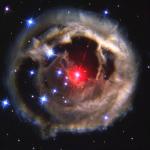 Light Echoes from V838 Mon
27.03.2003
Nominated for most mysterious star in the Milky Way, V838 Monocerotis briefly became one of the brightest stars in our galaxy. Its outburst discovered in January 2002, observations have indicated that V838 Mon somehow...
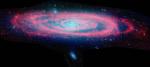 Infrared Andromeda
21.07.2007
This wide, detailed Spitzer Space Telescope view features infrared light from dust (red) and old stars (blue) in Andromeda, a massive spiral galaxy a mere 2.5 million light-years away. In fact, with over twice the diameter of our own Milky Way, Andromeda is the largest nearby galaxy.
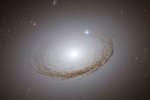 Unusual Dusty Galaxy NGC 7049
8.04.2009
How was this unusual looking galaxy created? No one is sure, especially since spiral galaxy NGC 7049 looks so strange. NGC 7049's strikingly appearance is primarily due to an unusually prominent dust ring seen mostly in silhouette. The opaque ring is much darker than the din of millions of bright stars glowing behind it.
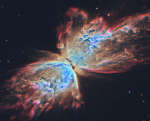 The Butterfly Nebula from Hubble
1.10.2014
The bright clusters and nebulae of planet Earth's night sky are often named for flowers or insects. Though its wingspan covers over 3 light-years, NGC 6302 is no exception. With an estimated surface...
 A Perseid Below
8.08.2021
Earthlings typically watch meteor showers by looking up. But this remarkable view, captured on August 13, 2011 by astronaut Ron Garan, caught a Perseid meteor by looking down. From Garan's perspective onboard...
 APOD: 2026 August 5 Б Spokes on Saturn's B Ring
5.08.2026
DonБt get spooked by SaturnБs ghostly spokes! Today we feature a nearly two-hour timelapse of Saturn and its rings looping forwards and backwards. A day on Saturn is only 10 hours long, so two hours of observation covers quite a bit of its rotation.
 M64: The Black Eye Galaxy
20.07.2023
This magnificent spiral galaxy is Messier 64, often called the Black Eye Galaxy or the Sleeping Beauty Galaxy for its dark-lidded appearance in telescopic views. The spiral's central region, about 7,400 light-years across, is pictured in this reprocessed image from the Hubble Space Telescope.
 The Galaxy Within Centaurus A
24.06.2004
Peering deep inside Centaurus A, the closest active galaxy to Earth, the Spitzer Space Telescope's penetrating infrared cameras recorded this startling vista. About 1,000 light-years across, the twisted cosmic dust cloud apparently shaped like a parallelogram is likely the result of a smaller spiral galaxy falling into the giant Centaurus A.
 Facing NGC 6946
24.02.2018
From our vantage point in the Milky Way Galaxy, we see NGC 6946 face-on. The big, beautiful spiral galaxy is located just 10 million light-years away, behind a veil of foreground dust and stars in the high and far-off constellation of Cepheus.
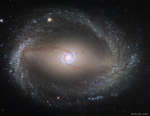 Spiral Galaxy NGC 1512: The Inner Rings
8.05.2022
Most galaxies don't have any rings -- why does this galaxy have two? To begin, the bright band near NGC 1512's center is a nuclear ring, a ring that surrounds the galaxy center and glows brightly with recently formed stars.
|
January February March April May June July August September |
|||||||||||||||||||||||||||||||||||||||||||||||||