
|
You entered: dust
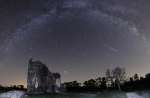 Perseid Prelude
12.08.2010
Each August, as planet Earth swings through dust trailing along the orbit of periodic comet Swift-Tuttle, skygazers can enjoy the Perseids Meteor Shower. The shower should build to its peak now, best seen from later tonight after moonset, until dawn tomorrow morning when Earth moves through the denser part of the wide dust trail.
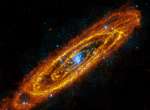 The Once and Future Stars of Andromeda
19.01.2011
The big, beautiful Andromeda Galaxy, aka M31, is a spiral galaxy a mere 2.5 million light-years away. Two space-based observatories have combined to produce this intriguing composite image of Andromeda, at wavelengths outside the visible spectrum. The remarkable view follows the locations of this galaxy's once and future stars.
 A Perseid Below
8.08.2024
Denizens of planet Earth typically watch meteor showers by looking up. But this remarkable view, captured on August 13, 2011 by astronaut Ron Garan, caught a Perseid meteor by looking down. From Garan...
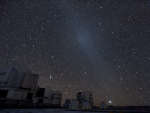 The Gegenschein Over Chile
7.05.2008
Is the night sky darkest in the direction opposite the Sun? No. In fact, a rarely discernable faint glow known as the gegenschein (German for "counter glow") can be seen 180 degrees around from the Sun in an extremely dark sky. The gegenschein is sunlight back-scattered off small interplanetary dust particles.
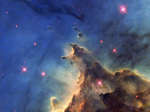 NGC 2174: Stars Versus Mountains
8.02.2011
It's stars versus gas mountains in NGC 2174 and the stars are winning. More precisely, the energetic light and winds from massive newly formed stars are evaporating and dispersing the dark stellar nurseries in which they formed.
 The Hercules Cluster of Galaxies
25.06.2014
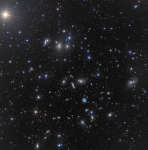
These are galaxies of the Hercules Cluster, an archipelago of island universes a mere 500 million light-years away. Also known as Abell 2151, this cluster is loaded with gas and dust rich, star-forming spiral galaxies but has relatively few elliptical galaxies, which lack gas and dust and the associated newborn stars.
 The Dark River to Antares
21.02.2015
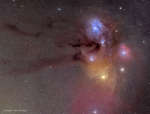
Connecting the Pipe Nebula to the colorful region near bright star Antares is a dark cloud dubbed the Dark River, flowing from the picture's left edge. Murky looking, the Dark River's appearance is caused by dust obscuring background starlight, although the dark nebula contains mostly hydrogen and molecular gas.
 Planet Building in HD 100546
2.05.2001
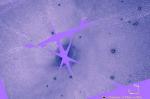
More than 100 billion boulders may be swarming in the disk around nearby star HD 100546. In a scene thought similar to the early years of our own Solar System, ever larger rocks are growing by colliding and accreting dust as the messy business of planet formation appears to be underway.
 The Cone Nebula Neighborhood
12.04.2007
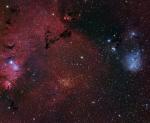
Cosmic clouds of hydrogen gas and dust abound in this gorgeous skyscape, stretching through Monocerous in the neighborhood of The Cone Nebula. A dark, obscuring dust cloud, the simple, sculpted shape of the Cone Nebula is near the lower left edge.
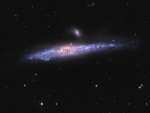 The Whale Galaxy
2.05.2009
NGC 4631 is a big beautiful spiral galaxy. Seen edge-on, it lies only 25 million light-years away in the well-trained northern constellation Canes Venatici. The galaxy's slightly distorted wedge shape suggests to some a cosmic herring and to others its popular moniker, The Whale Galaxy.
|
January February March April May June July August September |
|||||||||||||||||||||||||||||||||||||||||||||||||