
|
You entered: dust
 APOD: 2024 December 10 Б The Great Meteor Storm of 1833
10.12.2024
It was a night of 100,000 meteors. The Great Meteor Storm of 1833 was perhaps the most impressive meteor event in recent history. Best visible over eastern North America during the pre-dawn hours...
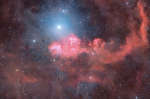 Ghosts in Cassiopeia
31.10.2025
Halloween is an astronomy holiday and spooky shapes always seem to lurk in planet Earth's night skies. In fact, near the center of this telescopic view toward the constellation Cassiopeia these swept-back interstellar clouds IC 59 (left) and IC 63 look ghostly on a cosmic scale.
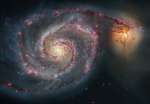 M51 Hubble Remix
14.06.2008
The 51st entry in Charles Messier's famous catalog is perhaps the original spiral nebula - a large galaxy with a well defined spiral structure also cataloged as NGC 5194. Over 60,000 light-years across, M51's spiral arms and dust lanes clearly sweep in front of its companion galaxy (right), NGC 5195.
 Cluster and Starforming Region Westerlund 2
25.04.2015
Located 20,000 light-years away in the constellation Carina, the young cluster and starforming region Westerlund 2 fills this cosmic scene. Captured with Hubble's cameras in near-infrared and visible light, the stunning image is a celebration of the 25th anniversary of the launch of the Hubble Space Telescope on April 24, 1990.
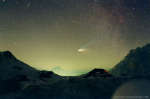 Comet Hale Bopp Over Val Parola Pass
9.04.2017
Comet Hale-Bopp, the Great Comet of 1997, became much brighter than any surrounding stars. It was seen even over bright city lights. Away from city lights, however, it put on quite a spectacular show. Here Comet Hale-Bopp was photographed above Val Parola Pass in the Dolomite mountains surrounding Cortina d'Ampezzo, Italy.
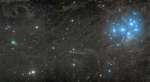 Two Comets and a Star Cluster
2.10.2017
Two unusual spots are on the move near the famous Pleiades star cluster. Shifting only a small amount per night, these spots are actually comets in our nearby Solar System that by chance wandered into the field of the light-years distant stars.
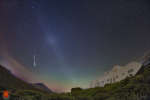 A Meteor and the Gegenschein
12.05.2021
Is the night sky darkest in the direction opposite the Sun? No. In fact, a rarely discernable faint glow known as the gegenschein (German for "counter glow") can be seen 180 degrees around from the Sun in an extremely dark sky. The gegenschein is sunlight back-scattered off small interplanetary dust particles.
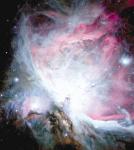 The Orion Nebula from CFHT
15.03.2004
Few astronomical sights excite the imagination like the nearby stellar nursery known as the Orion Nebula. The Nebula's glowing gas surrounds hot young stars at the edge of an immense interstellar molecular cloud only 1500 light-years away.
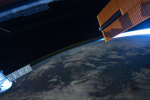 A Perseid Below
10.08.2014
Denizens of planet Earth typically watch meteor showers by looking up. But this remarkable view, captured on August 13, 2011 by astronaut Ron Garan, caught a Perseid meteor by looking down. From Garan...
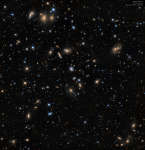 The Hercules Cluster of Galaxies
7.11.2020
These are galaxies of the Hercules Cluster, an archipelago of island universes a mere 500 million light-years away. Also known as Abell 2151, this cluster is loaded with gas and dust rich, star-forming spiral galaxies but has relatively few elliptical galaxies, which lack gas and dust and the associated newborn stars.
|
January February March April May |
|||||||||||||||||||||||||||||||||||||||||||||||||