
|
You entered: time
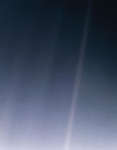 The Pale Blue Dot
14.02.2020
On Valentine's Day in 1990, cruising four billion miles from the Sun, the Voyager 1 spacecraft looked back one last time to make the first ever Solar System family portrait. The portrait consists...
 APOD Turns Eight
16.06.2003
The first APOD appeared eight years ago today, on 1995 June 16. To date, we estimate that APOD has now served over 100 million space-related images. We again thank our readers and NASA...
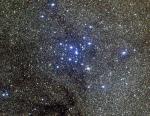 The M7 Open Star Cluster in Scorpius
22.02.2004
M7 is one of the most prominent open clusters of stars on the sky. The cluster, dominated by bright blue stars, can be seen with the naked eye in a dark sky in the tail of the constellation of Scorpius.
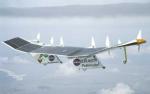 ERAST Pathfinder Plus: Daedalus Defied
12.08.1998
Daedalus warned Icarus that if he flew too high, the Sun would melt his wings. Apparently, nobody gave the ERAST Pathfinder-Plus aircraft a similar warning. Earlier this month, not only did Pathfinder-Plus fly higher than any previous propeller-driven aircraft - its wings converted sunlight into power.
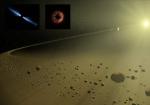 Debris Disks Surround Distant Suns
10.12.2004
In this dramatic artist's vision, debris along the outer reaches of a planet forming disk orbits in the glare of a distant sun. But inset are actual images of such disks around two nearby stars - AU Microscopii (top left; edge-on) and HD107146 (right: face-on) - as seen by the Hubble Space Telescope.
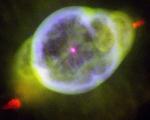 NGC 3242: The Ghost of Jupiter
29.10.2005
After a star like the Sun completes fusion in its core, it throws off its outer layers in a brief, beautiful cosmic display called a planetary nebula. NGC 3242 is such a planetary nebula, with the stellar remnant white dwarf star visible at the center.
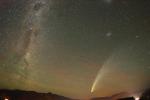 Comet McNaught Over New Zealand
12.02.2007
Comet McNaught is perhaps the most photogenic comet of our time. After making quite a show in the northern hemisphere in mid January, the comet moved south and developed a long and unusual dust tail that dazzled southern hemisphere observers starting in late January.
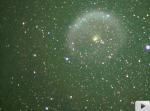 A Rocket Debris Cloud Drifts
26.02.2007
What's that cloud drifting in space? It's not an astronomical nebula -- those appear to stay put. Atmospheric clouds don't look like this. The answer to last week's sky mystery turned out to be orbiting and expanding debris from the upper stage of a failed Russian rocket that exploded unexpectedly.
 Lunation
5.02.2012
Our Moon's appearance changes nightly. This time-lapse sequence shows what our Moon looks like during a lunation, a complete lunar cycle. As the Moon orbits the Earth, the half illuminated by the Sun first becomes increasingly visible, then decreasingly visible. The Moon always keeps the same face toward the Earth.
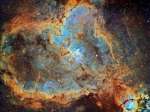 IC 1805: The Heart Nebula
4.03.2013
Sprawling across almost 200 light-years, emission nebula IC 1805 is a mix of glowing interstellar gas and dark dust clouds. Derived from its Valentine's-Day-approved shape, its nickname is the Heart Nebula. About 7,500 light-years away in the Perseus spiral arm of our galaxy, stars were born in IC 1805.
|
January February March April May June July August September |
|||||||||||||||||||||||||||||||||||||||||||||||||