
|
You entered: time
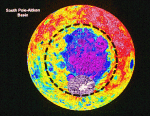 The Largest Impact Crater
6.09.1996
What is the largest known impact crater in the Solar System? Over 1300 miles across, the South Pole-Aitken Basin on the farside of Earth's Moon holds that distinction. Circled above in a false color mosaic of Clementine images it was caused when an asteroid or comet sized object crashed
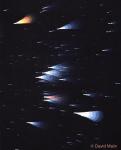 Orion's Star Colors
2.12.1996
What determines a star's color? Its temperature. Red stars are cool, with temperatures of around 3,000 degrees Kelvin (K), while blue stars are hotter and can have temperatures over 30,000 degrees K. Our own lovely yellow Sun's temperature is a comforting 6,000 degrees K.
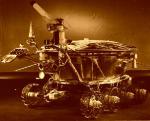 Lunokhod: Moon Robot
9.01.1999
On November 17, 1970 the Soviet Luna 17 spacecraft landed the first roving remote-controlled robot on the Moon. Known as Lunokhod 1, it weighed just under 2,000 pounds and was designed to operate...
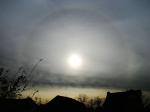 A Sun Halo Over Tennessee
9.03.2005
Sometimes it looks like the Sun is being viewed through a large lens. In the above case, however, there are actually millions of lenses: ice crystals. As water freezes in the upper atmosphere, small, flat, six-sided, ice crystals might be formed.
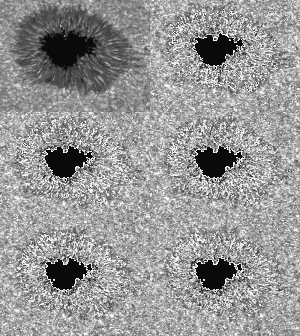 Sunspot Seething
23.02.2000
Our Sun's surface is continually changing. This time-lapse movie shows in five seconds what happens in 20 minutes on the Sun's surface near a sunspot. Visible is boiling granulation outside the sunspot...
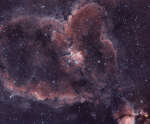 IC 1805: The Heart Nebula in HDR
25.10.2011
What powers the Heart Nebula? The large emission nebula dubbed IC 1805 looks, in whole, like a human heart. The nebula glows brightly in red light emitted by its most prominent element: hydrogen. The red glow and the larger shape are all created by a small group of stars near the nebula's center.
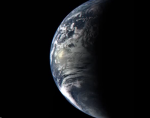 Leaving Earth
5.08.2013
What it would look like to leave planet Earth? Such an event was recorded visually in great detail by the MESSENGER spacecraft as it swung back past the Earth, eight years ago, on its way in toward the planet Mercury. Earth can be seen rotating in this time-lapse video, as it recedes into the distance.
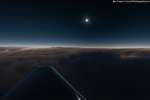 Eclipse at 44 000 Feet
7.11.2013
Timing was critical to catch this image of November 3rd's solar eclipse. But flying at 44,000 feet, intrepid eclipse chasers on a chartered jet traveling 500 miles per hour managed to intercept the the Moon's shadow. The remarkable flight made a perpendicular crossing of the central shadow track.
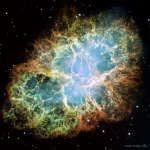 M1: The Crab Nebula from Hubble
16.08.2015
This is the mess that is left when a star explodes. The Crab Nebula, the result of a supernova seen in mysterious filaments. The filaments are not only tremendously complex, but appear to have less mass than expelled in the original supernova and a higher speed than expected from a free explosion.
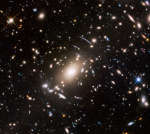 Galaxy Cluster Abell S1063 and Beyond
22.07.2016
Some 4 billion light-years away, galaxies of massive Abell S1063 cluster near the center of this sharp Hubble Space Telescope snapshot. But the fainter bluish arcs are magnified images of galaxies that lie far beyond Abell S1063.
|
January February March April May June July August September |
|||||||||||||||||||||||||||||||||||||||||||||||||