
|
You entered: time
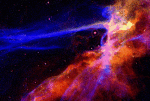 Rampaging Fronts of the Veil Nebula
7.03.1996
A supernova explosion of a high-mass star results in fast moving blast waves. At the front of the waves shown above, ionized gas in the Veil Supernova Remnant rushes out from the explosion, sweeps up material, and breaks up many atoms into constituent ions and electrons.
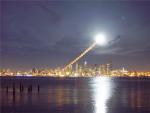 Moonrise Over Seattle
11.10.2003
Is the Moon larger when near the horizon? No -- as shown above, the Moon appears to be very nearly the same size no matter its location on the sky. Oddly, the cause or causes for the common Moon Illusion are still being debated.
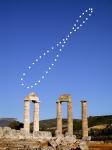 Analemma Over Ancient Nemea
21.06.2004
An anelemma is that figure-8 curve that you get when you mark the position of the Sun at the same time each day throughout planet Earth's year. Above, 44 separate exposures (plus...
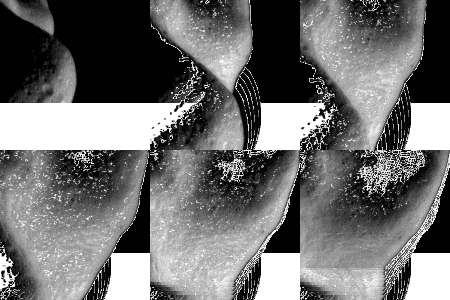 Flying Over Asteroid Eros
27.03.2000
What would it look like to fly over an asteroid? Spacecraft NEAR Shoemaker in orbit around asteroid 433 Eros found out earlier this month when it recorded its first fly-over sequence. The saddle region of the Sun-orbiting space-mountain appears to zip past the camera in this condensed hour-long time-lapse sequence.
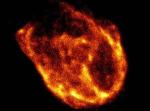 Supernova Remnant N132D in X Rays
13.09.1999
Thousands of years after a star explodes, an expanding remnant may still glow brightly. Such is the case with N132D, a supernova remnant located in the neighboring Large Magellanic Cloud galaxy. The expanding shell from this explosion now spans 80 light-years and has swept up about 600 Suns worth of mass.
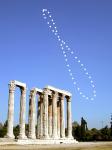 The Analemma and the Temple of Olympian Zeus
23.12.2006
An analemma is that figure-8 curve you get when you mark the position of the Sun at the same time each day throughout planet Earth's year. Above, 47 separate exposures (plus one foreground...
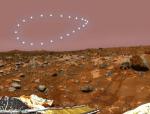 Martian Analemma
30.12.2006
On planet Earth, an analemma is the figure-8 loop you get when you mark the position of the Sun at the same time each day throughout the year. But similarly marking the position...
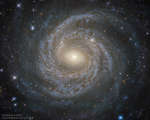 NGC 6814: Grand Design Spiral Galaxy from Hubble
21.06.2016
In the center of this serene stellar swirl is likely a harrowing black-hole beast. The surrounding swirl sweeps around billions of stars which are highlighted by the brightest and bluest. The breadth and beauty of the display give the swirl the designation of a grand design spiral galaxy.
 The Cosmic Infrared Background
6.02.2002
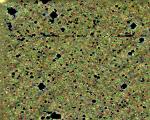
What cosmic wallpaper is on the sky? The answer depends on the type of light considered, and for some wavelengths, all the cluttering material in the foreground makes it still unknown. Recently, however...
 The Sun Sets on Comet Hyakutake
28.04.1996
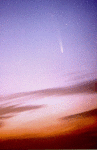
Comet Hyakutake is seen here just as the Sun sets on April 22. As April draws to a close, Comet Hyakutake will be visible only just after sunset and will be hard to discern against the brightly lit sky.
|
January February March April May June July August September |
|||||||||||||||||||||||||||||||||||||||||||||||||