
|
You entered: cluster
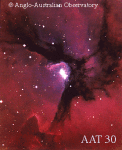 Hot Stars in the Trifid Nebula
21.12.1995
In the center of the glowing red gas on the Trifid Nebula lies an open cluster of young hot stars. The energetic light from these stars strikes hydrogen atoms in the surrounding nebula causing them to lose their electrons.
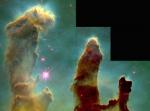 M16: Stars from Eagle's EGGs
24.04.2005
Newborn stars are forming in the Eagle Nebula. This image, taken with the Hubble Space Telescope in 1995, shows evaporating gaseous globules (EGGs) emerging from pillars of molecular hydrogen gas and dust. The giant pillars are light years in length and are so dense that interior gas contracts gravitationally to form stars.
 A Milky Way Band
10.07.2011
Most bright stars in our Milky Way Galaxy reside in a disk. Since our Sun also resides in this disk, these stars appear to us as a diffuse band that circles the sky.
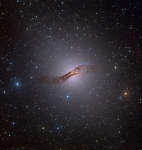 Centaurus A
17.03.2022
A mere 11 million light-years away, Centaurus A is the closest active galaxy to planet Earth. Spanning over 60,000 light-years, the peculiar elliptical galaxy also known as NGC 5128, is featured in this sharp telescopic view.
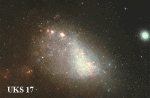 The Small Cloud of Magellan
19.09.1995
Almost unknown to casual observers in the northern hemisphere, the southern sky contains two diffuse wonders known as the Magellanic Clouds. The Magellanic Clouds are small irregular galaxies orbiting our own larger Milky Way spiral galaxy.
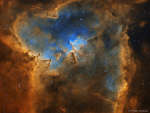 The Heart Nebula in Hydrogen, Oxygen, and Sulfur
27.08.2017
What powers the Heart Nebula? The large emission nebula dubbed IC 1805 looks, in whole, like a heart. The nebula's glow -- as well as the shape of the gas and dust clouds -- is powered by by stellar winds and radiation from massive hot stars in the nebula's newborn star cluster Melotte 15.
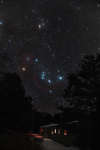 Northern Winter Night
25.12.2020
Orion always seems to come up sideways on northern winter evenings. Those familiar stars of the constellation of the Hunter are caught above the trees in this colorful night skyscape. Not a star at all but still visible to eye, the Great Nebula of Orion shines below the Hunter's belt stars.
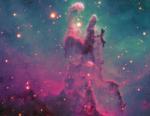 Eagle Castle
30.07.1997
What lights up this castle of star formation? The familiar Eagle Nebula glows much like a neon sign, but in many colors at once. The above photograph is a composite of three of these glowing gas colors.
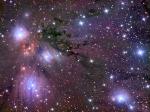 Stars, Dust and Nebula in NGC 2170
28.02.2007
When stars form, pandemonium reigns. A textbook case is the star forming region NGC 2170. Visible above are red glowing emission nebulas of hydrogen, blue reflection nebulas of dust, dark absorption nebulas of dust, and the stars that formed from them.
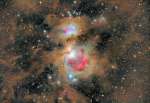 Dust of the Orion Nebula
6.02.2012
What surrounds a hotbed of star formation? In the case of the Orion Nebula -- dust. The entire Orion field, located about 1600 light years away, is inundated with intricate and picturesque filaments of dust.
|
January February March April May June July August September October |
|||||||||||||||||||||||||||||||||||||||||||||||||