
|
You entered: cluster
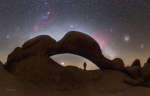 Seeking Venus under the Spitzkoppe Arch
2.11.2015
What's that in the sky? Although there was much to see in this spectacular panorama taken during the early morning hours of a day in late September, the brightest object in the sky was clearly the planet Venus.
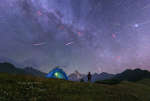 Meteors over Four Girl Mountains
12.12.2016
On some nights it rains meteors. Peaking over the next two nights, asteroid dust is expected to rain down on Earth during the annual Geminids meteor shower. This year, unfortunately, fainter Geminids will be harder to see because of the brightness of the Long Nights Full Moon, which occurs Wednesday.
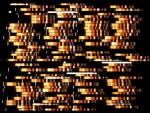 Breaking Distant Light
18.03.2002
In the distant universe, time appears to run slow. Since time-dilated light appears shifted toward the red end of the spectrum (redshifted), astronomers are able to use cosmological time-slowing to help measure vast distances in the universe.
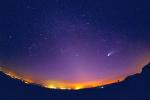 A Fisheye View of Comet Hale-Bopp
25.08.1997
Thousands of stars, several constellations, a planet and a comet all graced the western horizon over Ujue, Spain just after sunset on April 4th, 1997. Because the picture was taken with a fisheye lens, much of the whole night sky is visible. Comet Hale-Bopp, with both tails blazing, appears right of center.
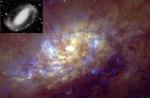 Starbirth in NGC 1808
22.03.1998
The center of galaxy NGC 1808 is bursting with new stars, but why? Being a barred spiral galaxy makes NGC 1808 somewhat similar to our own Milky Way Galaxy. But the disk of NGC 1808 (inset) is quite warped, and its center is unusually bright and blue.
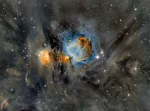 Orion Nebula in Surrounding Dust
25.03.2014
What surrounds a hotbed of star formation? In the case of the Orion Nebula -- dust. The entire Orion field, located about 1600 light years away, is inundated with intricate and picturesque filaments of dust.
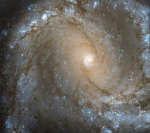 In the Center of Spiral Galaxy M61
20.05.2014
M61 is a barred spiral galaxy located in the nearby Virgo Cluster of Galaxies. Visible in M61 are a host of features common to spiral galaxies: bright spiral arms, a central bar, dust lanes, and bright knots of stars. M61, also known as NGC 4303, in similar to our own Milky Way Galaxy.
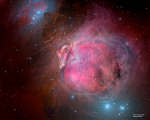 The Great Turkey Nebula
25.11.2020
Surprisingly reminiscent of The Great Nebula in Orion, The Great Turkey Nebula spans this creative field of view. Of course if it were the Orion Nebula it would be our closest large stellar nursery, found at the edge of a large molecular cloud a mere 1,500 light-years away.
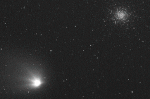 Comet Hale-Bopp Passes M14
11.11.1996
Comet Hale-Bopp continues its slow trek across the night sky, and can now be seen superposed near the bright globular cluster M14. Will Comet Hale-Bopp become as bright in early 1997 as Comet Hyakutake did in early 1996? It is still too early to tell.
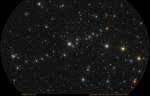 Kemble s Cascade
27.01.2010
An asterism is just a recognized pattern of stars that is not one the 88 official constellations. For example, one of the most famous (and largest) asterisms is the Big Dipper within the constellation Ursa Major.
|
January February March April May June July August September October |
|||||||||||||||||||||||||||||||||||||||||||||||||