
|
You entered: cluster
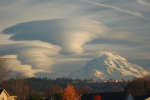 Lenticular Clouds Over Washington
4.11.2012
Are those UFOs near that mountain? No -- they are multilayered lenticular clouds. Moist air forced to flow upward around mountain tops can create lenticular clouds. Water droplets condense from moist air cooled below the dew point, and clouds are opaque groups of water droplets.
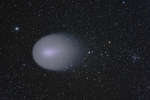 Comet Holmes Over Hungary
4.12.2007
Comet Holmes refuses to fade. The unusual comet that surprisingly brightened nearly a million-fold in late October continues to remain visible to the unaided eye from dark locations. Night to night, Comet 17P/Holmes is slowly gliding through the constellation Perseus, remaining visible to northern observers during much of the night right from sunset.
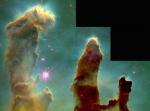 M16: Stars from Eagle's EGGs
24.11.2001
Newborn stars are forming in the Eagle Nebula. This image, taken with the Hubble Space Telescope in 1995, shows evaporating gaseous globules (EGGs) emerging from pillars of molecular hydrogen gas and dust. The giant pillars are light years in length and are so dense that interior gas contracts gravitationally to form stars.
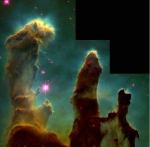 M16: Stars from Eagle's Eggs
24.09.2000
Newborn stars are forming in the Eagle Nebula. This image, taken with the Hubble Space Telescope in 1995, shows evaporating gaseous globules (EGGs) emerging from pillars of molecular hydrogen gas and dust. The giant pillars are light years in length and are so dense that
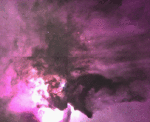 A Close-Up of the Lagoon Nebula
20.08.1996
Ribbons of red-glowing gas and dark dust surround massive young stars in this close-up of the Lagoon Nebula taken by the Hubble Space Telescope. The Lagoon Nebula is relatively close and bright - it appears larger than the Full Moon and is visible even without a telescope.
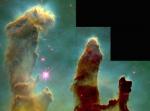 M16: Stars from Eagles EGGs
26.10.2003
Newborn stars are forming in the Eagle Nebula. This image, taken with the Hubble Space Telescope in 1995, shows evaporating gaseous globules (EGGs) emerging from pillars of molecular hydrogen gas and dust. The giant pillars are light years in length and are so dense that interior gas contracts gravitationally to form stars.
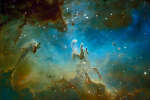 The Pillars of Eagle Castle
10.07.2009
What lights up this castle of star formation? The familiar Eagle Nebula glows bright in many colors at once. The above image is a composite of three of these glowing gas colors. Pillars of dark dust nicely outline some of the denser towers of star formation.
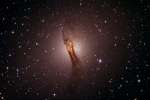 Centaurus A
12.03.2010
Only 11 million light-years away, Centaurus A is the closest active galaxy to planet Earth. Spanning over 60,000 light-years, the peculiar elliptical galaxy, also known as NGC 5128, is featured in this sharp color image.
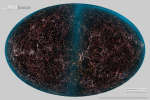 One Million Galaxies
26.12.2010
Are the nearest galaxies distributed randomly? A plot of over one million of the brightest "extended sources" detected by the Two Micron All Sky Survey (2MASS) shows that they are not. The vast majority of these infrared extended sources are galaxies.
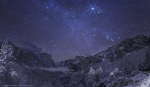 Yosemite Winter Night
25.12.2012
In this evocative night skyscape a starry band of the Milky Way climbs over Yosemite Valley, Sierra Nevada Range, planet Earth. Jupiter is the brightest celestial beacon on the wintry scene, though. Standing nearly opposite the Sun in the constellation Taurus, the wandering planet joins yellowish Aldebaran and the Hyades star cluster.
|
January February March April May June July August September October |
|||||||||||||||||||||||||||||||||||||||||||||||||