
|
You entered: Sun
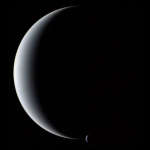 Crescent Neptune and Triton
13.12.2009
Gliding silently through the outer Solar System, the Voyager 2 spacecraft camera captured Neptune and Triton together in crescent phase in 1989. The above picture of the gas giant planet and its cloudy moon was taken from behind just after closest approach.
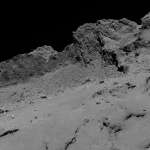 Rosetta s Farewell
1.10.2016
After closely following comet 67P/Churyumov-Gerasimenko for 786 days as it rounded the Sun, the Rosetta spacecraft's controlled impact with the comet's surface was confirmed by the loss of signal from the spacecraft on September 30, 2016.
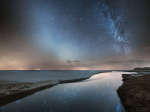 Dueling Bands in the Night
27.02.2018
What are these two bands in the sky? The more commonly seen band is the one on the right and is the central band of our Milky Way galaxy. Our Sun orbits...
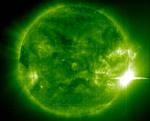 Flare Well AR 10486
6.11.2003
Almost out of view from our fair planet, rotating around the Sun's western edge, giant sunspot region AR 10486 lashed out with another intense solar flare followed by a large coronal mass ejection (CME) on Tuesday, November 4th at about 1950 Universal Time.
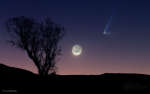 Comet PanSTARRS and a Crescent Moon
20.07.2015
A comet has brightened quickly and unexpectedly. Discovered last year, Comet C/2014 Q1 (PanSTARRS) is expected to be visible now for a few days to the unaided eye, just after sunset, from some locations. The comet rounded the Sun on July 6 and apparently has shed quite a bit of gas and dust.
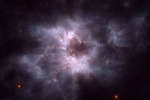 NGC 2440: Cocoon of a New White Dwarf
21.02.2010
Like a butterfly, a white dwarf star begins its life by casting off a cocoon that enclosed its former self. In this analogy, however, the Sun would be a caterpillar and the ejected shell of gas would become the prettiest of all!
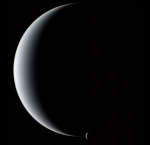 Crescent Neptune and Triton
14.04.2013
Gliding silently through the outer Solar System, the Voyager 2 spacecraft camera captured Neptune and Triton together in crescent phase in 1989. The elegant picture of the gas giant planet and its cloudy moon was taken from behind just after closest approach.
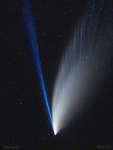 APOD: 2020 July 22 Б The Structured Tails of Comet NEOWISE
22.07.2020
What is creating the structure in Comet NEOWISE's tails? Of the two tails evident, the blue ion tail on the left points directly away from the Sun and is pushed out by the flowing and charged solar wind.
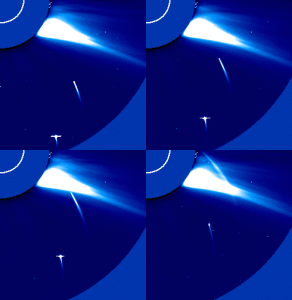 SOHOs Twin Sungrazers
11.06.1998
This four frame animation (courtesy D. Biesecker) shows two comets arcing toward a fatal fiery encounter with the Sun. These discovery images were recorded by the LASCO instrument on board the space-based SOHO solar observatory on June 1-2.
 APOD: 2025 July 13 Б Planetary Nebula Mz3: The Ant Nebula
13.07.2025
Why isn't this ant a big sphere? Planetary nebula Mz3 is being cast off by a star similar to our Sun that is, surely, round. Why then would the gas that is streaming away create an ant-shaped nebula that is distinctly not round?
|
January February March April May June July August September |
|||||||||||||||||||||||||||||||||||||||||||||||||