
|
You entered: Sun
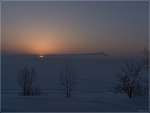 Sunset, Moonset
7.01.2011
Seen from central and northern Asia, the Sun and New Moon set together on January 4, in a partial solar eclipse. Close to its maximum phase, the eclipse is captured near the moment of sunset in this wintry scene from the bank of the Berd River near Novosibirsk, Siberia, Russia.
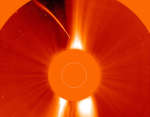 Sungrazer
27.10.2013
Arcing toward a fiery fate, this Sungrazer comet was recorded by the SOHO spacecraft's Large Angle Spectrometric COronagraph(LASCO) on December 23, 1996. LASCO uses an occulting disk, partially visible at the lower...
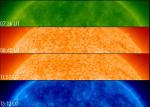 Mercury Spotting
8.05.2003
Can you spot the planet? The diminutive disk of Mercury, the solar system's innermost planet, spent about five hours crossing in front of the enormous solar disk yesterday (Wednesday, May 7th), as viewed from the general vicinity of planet Earth.
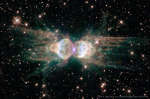 Planetary Nebula Mz3: The Ant Nebula
26.04.2015
Why isn't this ant a big sphere? Planetary nebula Mz3 is being cast off by a star similar to our Sun that is, surely, round. Why then would the gas that is streaming away create an ant-shaped nebula that is distinctly not round?
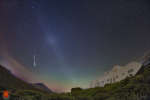 A Meteor and the Gegenschein
12.05.2021
Is the night sky darkest in the direction opposite the Sun? No. In fact, a rarely discernable faint glow known as the gegenschein (German for "counter glow") can be seen 180 degrees around from the Sun in an extremely dark sky. The gegenschein is sunlight back-scattered off small interplanetary dust particles.
 Galileo Demonstrates the Telescope
30.08.1996
Galileo Galilei made a good discovery great. Upon hearing at age 40 that a Dutch optician had invented a glass that made distant objects appear larger, Galileo crafted his own telescope and turned it toward the sky.
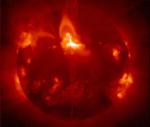 Active Regions, CMEs, and X Class Flares
8.06.2000
Space Weather forcasters are predicting major storm conditions over the next few days as the active Sun has produced at least three strong flares and a large coronal mass ejection (CME) since Tuesday, June 6th.
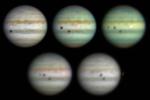 A Triple Eclipse on Jupiter
2.02.1998
Part of Jupiter is missing. Actually, three parts appear to be missing. In reality though, the three dark spots seen in the above photograph are only shadows. The unusual alignment of three of Jupiter's moons between the Jovian giant and the Sun was imaged last November 10th.
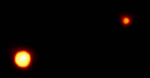 Pluto: The Frozen Planet
18.08.1995
The Hubble Space Telescope imaged Pluto and its moon Charon in 1994. Pluto is usually the most distant planet from the Sun but because of its elliptic orbit Pluto crossed inside of Neptune's orbit in 1979 and will cross back out again in 1999.
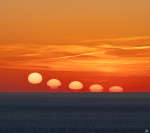 APOD: 2026 April 25 Б The Persistence of Sunlight
25.04.2026
This seaside sunset offered a surreal experience, captured in a sea and skyscape from the west coast of Sardinia, Italy, planet Earth. The Daliesque scene is a composition of sequential exposures made with a camera and long telephoto lens. The Sun is not melting, though.
|
January February March April May June July August September |
|||||||||||||||||||||||||||||||||||||||||||||||||