
|
You entered: time
 The Moona Lisa
14.09.2024
Only natural colors of the Moon in planet Earth's sky appear in this creative visual presentation. Arranged as pixels in a framed image, the lunar disks were photographed at different times. Their varying hues are ultimately due to reflected sunlight affected by changing atmospheric conditions and the alignment geometry of Moon, Earth, and Sun.
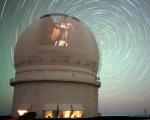 CFHT Star Trails
5.09.2000
High atop a dormant volcano in Hawaii, an eye 3.6-meters wide stares at a faint light on the night sky. Unlike a human eye, which collects light for only a fraction of a second at a time, a telescope such as the Canada-France-Hawaii Telescope (CFHT) can collect light for hours.
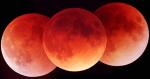 A Lunar Eclipse in Three Exposures
25.01.2000
Our Moon turned red last week. The reason was that during the night of January 20, a total lunar eclipse occurred. The above digitally superimposed photographs captured the Moon three times during this lunar...
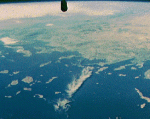 Aristarchus' Unbelievable Discoveries
14.09.1996
Here lived one of the greatest thinkers in human history. Aristarchus lived on the Greek island of Samos, a small island in the center of the above picture that can be identified with a good map.
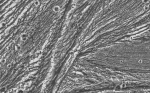 Galileo Photographs Ganymede
10.07.1996
Ganymede's surface is slowly being pulled apart. This photo of Ganymede was released earlier today by the Galileo team at NASA. The Galileo Spacecraft arrived at Jupiter in December 1995. In late June...
 Vega
Vega
15.07.1997
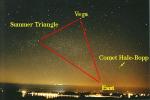
Vega is a bright blue star 25 light years away. Vega is the brightest star in the Summer Triangle, a group of stars easily visible summer evenings in the northern hemisphere. The name Vega...
 Aristarchus' Unbelievable Discoveries
8.11.1997
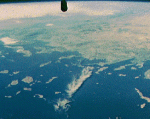
Here lived one of the greatest thinkers in human history. Aristarchus lived on the Greek island of Samos, a small island in the center of the above picture that can be identified with a good map.
 Gamma Ray Quasar
26.12.1998
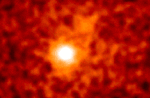
The bright object in the center of the false color image above is quasar 3C279 viewed in gamma-rays, photons with more than 40 million times the energy of visible light. Like all quasars, 3C279 is a nondescript, faint, star-like object in the visible sky.
 An Erupting Solar Prominence from SOHO
7.08.2006
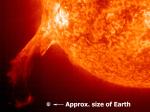
Our Sun is still very active. In the year 2000, our Sun went though Solar Maximum, the time in its 11-year cycle where the most sunspots and explosive activities occur. Sunspots, the Solar Cycle, and solar prominences are all caused by the Sun's changing magnetic field.
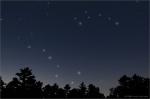 The Big Dipper
8.01.2007
Do you see it? This common question frequently precedes the rediscovery of one of the most commonly recognized configurations of stars on the northern sky: the Big Dipper. This grouping of stars is one of the few things that has likely been seen, and will be seen, by every generation.
|
January February March April May June July August September |
|||||||||||||||||||||||||||||||||||||||||||||||||