
|
You entered: time
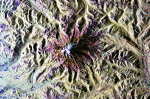 A Radar Image of Planet Earth
24.08.1995
This image of Mt. Rainier, Washington USA, planet Earth, was produced by the Spaceborne Radar Laboratory which flew on the Space Shuttle Endeavour in 1994. Radar, short for RAdio Detection And Ranging...
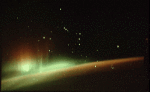 Aurora and Orion
14.11.1995
Looking toward the south from low Earth orbit, the crew of the Space Shuttle Endeavor made this stunning time exposure of the Aurora Australis (southern lights) in April of 1994. The aurora are caused by high energy electrons from the Solar Wind which are funneled into the atmosphere by the Earth's magnetic field.
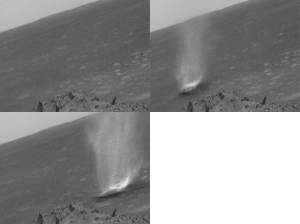 A Martian Dust Devil Passes
26.04.2005
What goes there across the plains of Mars? A dust devil. For the first time, definitive movies of the famous spinning dust towers have been created from ground level. The robot rover Spirit has now imaged several dust devils from its hillside perch just within the past two months.
 Gemini South Star Trails
1.09.2006
Stars seem to arc through southern skies in this surrealistic time exposure -- recorded before moonrise from the Gemini South Observatory, Cerro Pachon, Chile, Planet Earth. During the one hour 40 minute exposure camera and tripod were fixed, so the concentric star trails are a reflection of Earth's daily rotation about its axis.
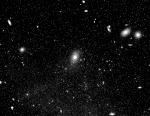 The Virgo Cluster of Galaxies
20.02.2000
Pictured are several galaxies of the Virgo Cluster, the closest cluster of galaxies to our Milky Way Galaxy. The Virgo Cluster spans more than 5 degrees on the sky - about 10 times the angle made by a full Moon. It contains over 100 galaxies of many types - including spirals, ellipticals, and irregular galaxies.
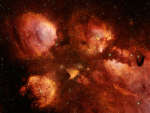 NGC 6334: The Cats Paw Nebula
4.03.2008
Nebulae are perhaps as famous for being identified with familiar shapes as perhaps cats are for getting into trouble. Still, no known cat could have created the vast Cat's Paw Nebula visible in Scorpius.
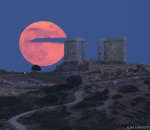 Strawberry Moon over the Temple of Poseidon
18.06.2019
Did you see the full moon last night? If not, tonight's nearly full moon should be almost as good. Because full moons are opposite the Sun, they are visible in the sky when the Sun is not -- which should be nearly all night long tonight, clouds permitting.
 Anticrepuscular Rays over Florida
18.03.2020
What's happening behind those clouds? Although the scene may appear somehow supernatural, nothing more unusual is occurring than a Sun setting on the other side of the sky. Pictured here are anticrepuscular rays. To understand them, start by picturing common crepuscular rays that are seen any time that sunlight pours though scattered clouds.
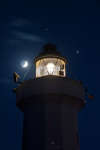 Great Conjunction over Sicilian Lighthouse
8.12.2020
DonБt miss the coming great conjunction. In just under two weeks, the two largest planets in our Solar System will angularly pass so close together in Earth's sky that the Moon would easily be able to cover them both simultaneously. This pending planetary passage -- on December 21 -- will be the closest since 1623.
 183 Days in the Sun
22.12.2023
A single 183 day exposure with a pinhole camera and photographic paper resulted in this long-duration solargraph. Recorded from solstice to solstice, June 21 to December 21, in 2022, it follows the Sun's daily arcing path through planet Earth's skies from Mertola, Portugal.
|
January February March April May June July August September |
|||||||||||||||||||||||||||||||||||||||||||||||||