
|
You entered: time
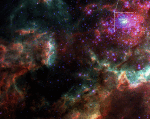 In the Center of 30 Doradus
21.02.1999
In the center of 30 Doradus lies a huge cluster of the largest, hottest, most massive stars known. The center of this cluster, known as R136, is boxed in the upper right portion of the above picture.
 The Universe Evolves
5.09.1999
Scroll right and watch the universe evolve. Above is a computer simulation depicting the evolution of our entire universe. On the far left is a slice of the universe soon after the Big Bang - over 10 billion years ago.
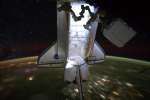 Endeavour s Starry Night
2.06.2011
This luminous night view of the space shuttle orbiter Endeavour, docked with the International Space Station for a final time, was captured on May 28. Orbiting 350 kilometers above planet Earth, Endeavour's payload bay is lit up as it hurtles through Earth's shadow at 27,000 miles per hour.
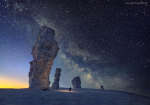 The Milky Way over the Seven Strong Men Rock Formations
3.04.2018
You may have heard of the Seven Sisters in the sky, but have you heard about the Seven Strong Men on the ground? Located just west of the Ural Mountains, the unusual Manpupuner rock formations are one of the Seven Wonders of Russia. How these ancient 40-meter high pillars formed is yet unknown.
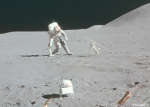 Astronaut Kicks Lunar Field Goal
1.04.2019
Score three points for NASA. With time running out late in Apollo 15's mission to the Moon in 1971, Astronaut David Scott prepared to split the uprights and bring about yet another dramatic end-of-the-mission victory for NASA. Scott used a special lunar football designed for the rugged games held on the Moon.
 Ring of Fire over Monument Valley
5.10.2023
Tracking along a narrow path, the shadow of a new moon will race across North, Central, and South America, on October 14. When viewed from the shadow path the apparent size of the lunar disk will not quite completely cover the Sun though.
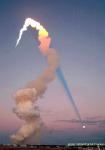 Shuttle Plume Shadow Points to Moon
19.02.2001
Why would the shadow of a space shuttle launch plume point toward the Moon? Two weeks ago during the launch of Atlantis, the Sun, Earth, Moon, and rocket were all properly aligned for this photogenic coincidence.
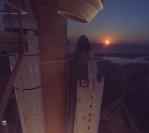 Discovery Spring
20.03.2001
Welcome to the equinox! Moving northward in Earth's sky, today the Sun crosses the celestial equator at 13:31 Universal Time bringing Spring to the north and Fall to the south. The change...
 Zimbabwe Sunset
21.06.2002
Today's scheduled geocentric astronomical event is the Solstice, with the Sun reaching its northernmost declination at 13 hours 24 minutes Universal Time. For denizens of planet Earth this Solstice marks the begining of Summer in the northern hemisphere and Winter in the south.
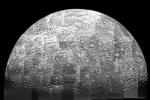 Outbound from Mercury
16.07.2002
After just passing Mercury, the robot spacecraft Mariner 10 looked back. The above picture is what it saw. Mercury, the closest planet to the Sun, is heavily cratered much like Earth's Moon.
|
January February March April May June July August September |
|||||||||||||||||||||||||||||||||||||||||||||||||