
|
You entered: gas
 APOD: 2025 June 26 Б The Seagull Nebula
26.06.2025
An interstellar expanse of glowing gas and obscuring dust presents a bird-like visage to astronomers from planet Earth, suggesting its popular moniker, the Seagull Nebula. This broadband portrait of the cosmic bird covers...
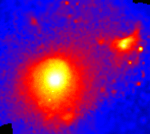 The Virgo Cluster: Hot Plasma and Dark Matter
19.04.1996
This ROSAT image of the Virgo cluster of galaxies reveals a hot X-ray emitting plasma or gas with a temperature of 10-100 million degrees pervading the cluster. False colors have been used to represent the intensity of X-ray emission.
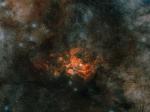 Star Forming Region NGC 6357
20.12.2006
For reasons unknown, NGC 6357 is forming some of the most massive stars ever discovered. Near the more obvious Cat's Paw nebula, NGC 6357 houses the open star cluster Pismis 24, home to these tremendously bright and blue stars.
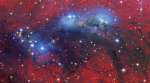 NGC 6914 Nebulae
4.03.2011
A dramatic study in contrasts, this colorful skyscape features stars, dust, and glowing gas in NGC 6914. The complex of nebulae lies some 6,000 light-years away, toward the high-flying northern constellation Cygnus and the plane of our Milky Way Galaxy.
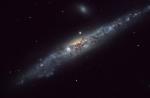 NGC 4631: The Whale Galaxy
29.03.2002
NGC 4631 is a big beautiful spiral galaxy seen edge-on only 25 million light-years away towards the small northern constellation Canes Venatici. This galaxy's slightly distorted wedge shape suggests to some a cosmic herring and to others the popular moniker of The Whale Galaxy.
 APOD: 2025 August 31 Б NGC 7027: The Pillow Planetary Nebula
31.08.2025
What created this unusual planetary nebula? Dubbed the Pillow Nebula and the Flying Carpet Nebula, NGC 7027 is one of the smallest, brightest, and most unusually shaped planetary nebulas known. Given its expansion rate, NGC 7027 first started expanding, as visible from Earth, about 600 years ago.
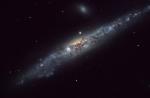 NGC 4631: The Whale Galaxy
23.01.2004
NGC 4631 is a big beautiful spiral galaxy seen edge-on only 25 million light-years away towards the small northern constellation Canes Venatici. This galaxy's slightly distorted wedge shape suggests to some a cosmic herring and to others the popular moniker of The Whale Galaxy.
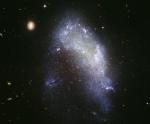 NGC 1427A: Galaxy in Motion
4.03.2005
In this tantalizing image, young blue star clusters and pink star-forming regions abound in NGC 1427A, a galaxy in motion. The small irregular galaxy's swept back outline points toward the top of this...
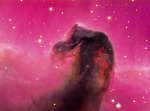 The Horsehead Nebula
27.12.2017
One of the most identifiable nebulae in the sky, the Horsehead Nebula in Orion, is part of a large, dark, molecular cloud. Also known as Barnard 33, the unusual shape was first discovered on a photographic plate in the late 1800s.
 APOD: 2024 October 1 Б Porphyrion: The Longest Known Black Hole Jets
1.10.2024
How far can black hole jets extend? A new record was found just recently with the discovery of a 23-million light-year long jet pair from a black hole active billions of years ago. Dubbed...
|
January February March April May |
|||||||||||||||||||||||||||||||||||||||||||||||||