
|
You entered: gas
 APOD: 2024 April 15 Б The Cigar Galaxy from Hubble and Webb
15.04.2024
Something strange happened to this galaxy, but what? Known as the Cigar Galaxy and cataloged as M82, red glowing gas and dust are being cast out from the center. Although this starburst galaxy...
 APOD: 2025 January 28 Б Comet G3 ATLAS over Uruguay
28.01.2025
Comets can be huge. When far from the Sun, a comet's size usually refers to its hard nucleus of ice and rock, which typically spans a few kilometers -- smaller than even a small moon.
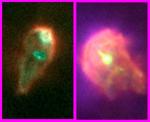 Protoplanetary Survivors in Orion
4.05.2001
The Orion Nebula is a nuturing stellar nursery filled with hot young stars and their natal clouds of gas and dust. But for planetary systems, the active star-forming region can present a hazardous and inhospitable birthplace.
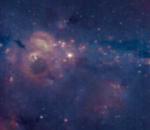 Journey to the Center of the Galaxy
22.04.2000
In Jules Verne's science fiction classic A Journey to the Center of the Earth, Professor Hardwigg and his fellow explorers encounter many strange and exciting wonders. What wonders lie at the center of our Galaxy?
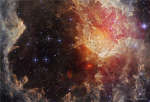 Stars and Dust Pillars in NGC 7822 from WISE
30.11.2014
Hot, young stars and cosmic pillars of gas and dust seem to crowd into NGC 7822. At the edge of a giant molecular cloud toward the northern constellation Cepheus, this glowing star forming region lies about 3,000 light-years away.
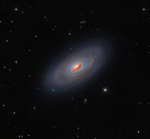 M64: The Black Eye Galaxy
18.06.2015
This big, bright, beautiful spiral galaxy is Messier 64, often called the Black Eye Galaxy or the Sleeping Beauty Galaxy for its heavy-lidded appearance in telescopic views. M64 is about 17 million light-years distant in the otherwise well-groomed northern constellation Coma Berenices.
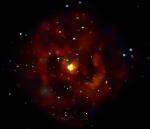 X Rays from M83
6.02.2003
Bright and beautiful spiral galaxy M83 lies a mere twelve million light-years from Earth, toward the headstrong constellation Hydra. Sweeping spiral arms, prominent in visible light images, lend this galaxy its popular moniker -- the Southern Pinwheel.
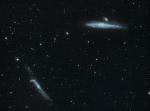 The Whale and the Hockey Stick
12.10.2007
NGC 4631 is a big beautiful spiral galaxy seen edge-on (top right) only 25 million light-years away towards the small northern constellation Canes Venatici. This galaxy's slightly distorted wedge shape suggests to some a cosmic herring and to others the popular moniker of The Whale Galaxy.
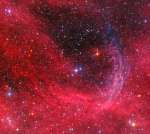 WR 134 Ring Nebula
21.06.2012
Made with narrow and broad band filters, this colorful cosmic snap shot covers a field of view about the size of the full Moon within the boundaries of the constellation Cygnus. It highlights the bright edge of a ring-like nebula traced by the glow of ionized hydrogen and oxygen gas.
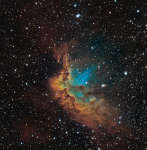 The Wizard Nebula
29.08.2014
Open star cluster NGC 7380 is still embedded in its natal cloud of interstellar gas and dust popularly known as the Wizard Nebula. Seen with foreground and background stars along the plane of our Milky Way galaxy it lies some 8,000 light-years distant, toward the constellation Cepheus.
|
January February March April May |
|||||||||||||||||||||||||||||||||||||||||||||||||