
|
You entered: gas
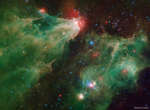 The Cave Nebula in Infrared from Spitzer
11.06.2019
What's happening in and around the Cave Nebula? To help find out, NASA's orbiting Spitzer Space Telescope looked into this optically-dark star-forming region in four colors of infrared light. The Cave Nebula...
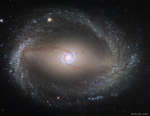 Spiral Galaxy NGC 1512: The Inner Rings
8.05.2022
Most galaxies don't have any rings -- why does this galaxy have two? To begin, the bright band near NGC 1512's center is a nuclear ring, a ring that surrounds the galaxy center and glows brightly with recently formed stars.
 APOD: 2024 April 1 Б Swirling Magnetic Field around Our Galaxys Central Black Hole
1.04.2024
What's happening to the big black hole in the center of our galaxy? It is sucking in matter from a swirling disk -- a disk that is magnetized, it has now been confirmed. Specifically, the black hole's accretion disk has recently been seen to emit polarized light, radiation frequently associated with a magnetized source.
 Bright Star Knots in NGC 4038
2.06.1997
This galaxy is having a bad millennium. In fact, the past 100 million years haven't been so good, and probably the next billion or so should be quite tumultuous. NGC 4039 was a normal spiral galaxy, minding its own business, when NGC 4038 crashed into it.
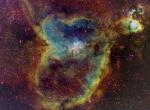 IC 1805: Light from the Heart
17.09.2004
Sprawling across hundreds of light-years, emission nebula IC 1805 is a mix of glowing interstellar gas and dark dust clouds. Only about 7,500 light-years away, stars were born in this region whose nickname - the Heart Nebula - derives from its suggestive shape (seen here sideways).
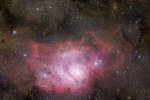 The Lagoon Nebula from GigaGalaxy Zoom
6.10.2009
The large majestic Lagoon Nebula is home for many young stars and hot gas. Spanning 100 light years across while lying only about 5000 light years distant, the Lagoon Nebulae is so big and bright that it can be seen without a telescope toward the constellation of Sagittarius.
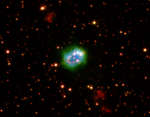 The Necklace Nebula
3.11.2010
The small constellation Sagitta sports this large piece of cosmic jewelry, dubbed the Necklace Nebula. The newly discovered example of a ring-shaped planetary nebula is about 15,000 light-years distant. Its bright ring with pearls of glowing gas is half a light-year across.
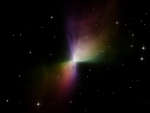 A Beautiful Boomerang Nebula
28.12.2007
This symmetric cloud dubbed the Boomerang Nebula was created by a high-speed wind of gas and dust blowing from an aging central star at speeds of nearly 600,000 kilometers per hour. The rapid...
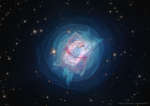 Bright Planetary Nebula NGC 7027 from Hubble
30.06.2020
What created this unusual planetary nebula? NGC 7027 is one of the smallest, brightest, and most unusually shaped planetary nebulas known. Given its expansion rate, NGC 7027 first started expanding, as visible from Earth, about 600 years ago.
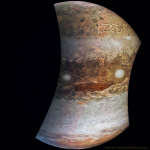 A Face in the Clouds of Jupiter from Juno
8.06.2021
What do you see in the clouds of Jupiter? On the largest scale, circling the planet, Jupiter has alternating light zones and reddish-brown belts. Rising zone gas, mostly hydrogen and helium, usually swirls around regions of high pressure. Conversely, falling belt gas usually whirls around regions of low pressure, like cyclones and hurricanes on Earth.
|
January February March April May |
|||||||||||||||||||||||||||||||||||||||||||||||||