
|
You entered: time
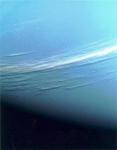 Two Hours Before Neptune
5.10.1999
Two hours before closest approach to Neptune in 1989, the Voyager 2 robot spacecraft snapped this picture. Clearly visible for the first time were long light-colored cirrus-type clouds floating high in Neptune's atmosphere. Shadows of these clouds can even be seen on lower cloud decks.
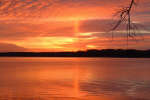 A Sun Pillar Over North Carolina
15.12.2008
Have you ever seen a sun pillar? When the air is cold and the Sun is rising or setting, falling ice crystals can reflect sunlight and create an unusual column of light. Ice sometimes forms flat, six-sided shaped crystals as it falls from high-level clouds.
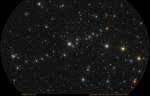 Kemble s Cascade
28.01.2010
An asterism is just a recognized pattern of stars that is not one the 88 official constellations. For example, one of the most famous (and largest) asterisms is the Big Dipper within the constellation Ursa Major.
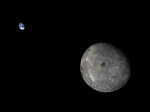 Moon and Earth from Chang e 5 T1
3.11.2014
Described at times as a big blue marble, from some vantage points Earth looks more like a small blue marble. Such was the case in this iconic image of the Earth and Moon system taken by the Chang'e 5-T1 mission last week.
 Fireball in the Arctic
25.12.2017
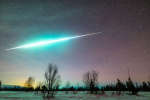
Something very bright suddenly lit up the arctic -- what was it? The original idea was to take a series of aurora images that could be made into a time-lapse video. But when night suddenly turned into day, the astrophotographer quickly realized that he was seeing something even more spectacular.
 APOD: 2024 November 5 Б Milky Way over Easter Island
5.11.2024
Why were the statues on Easter Island built? No one is sure. What is sure is that over 900 large stone statues called moais exist there. The Rapa Nui (Easter Island) moais stand, on average, over twice as tall as a person and have over 200 times as much mass.
 The Milky Way Through the Summer Triangle
12.12.1996
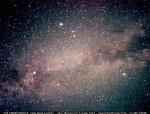
There are more than a few stars in our Galaxy. The light from many of them combines to appear as a wisp of faint light across the night sky - the Milky Way.
 Super Typhoon Winnie
19.08.1997
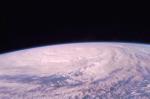
Super Typhoon Winnie raged through parts of the Eastern Hemisphere last week. Swirling in the Pacific Ocean with winds in excess of 160 miler per hour, Winnie became one of the stronger storm systems in modern times: a Category 5 Hurricane.
 Micro-Quasar GRS1915 Puffs
2.12.1997
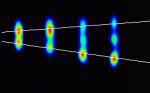
On the far side of our Galaxy, gas clouds explode away from a small black hole. This might seem peculiar, as black holes are supposed to attract matter. But material falling toward a black hole collides and heats up, creating an environment similar to a quasar that is far from stable.
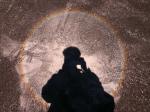 Identify this Phenomenon
13.09.2004
What caused this ring of colors? At the time of this writing, MIT Physics Professor Walter Lewin had yet to find someone who can give the correct explanation. Not students. Not colleagues. Not APOD editors. He wonders how the astute readers of APOD will do. Can you match wits with Professor Lewin?
|
January February March April May June July August September |
|||||||||||||||||||||||||||||||||||||||||||||||||