
|
You entered: time
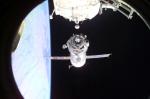 Leaving the International Space Station
17.12.2001
It was time to go home. During their eight days aboard the Earth-orbiting International Space Station (ISS), ESA Flight Engineer Claudie Haigner, Russian Commander Victor Afanasyev, and Russian Flight Engineer Konstantin Kozeev had completed several experiments and successfully delivered a new lifeboat.
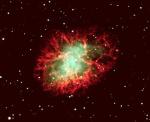 M1: Filaments of the Crab Nebula
8.02.1998
The Crab Nebula, filled with mysterious filaments, is the result of a star that exploded in 1054 AD. This spectacular supernova explosion was recorded by Chinese and (quite probably) Anasazi Indian astronomers. The filaments...
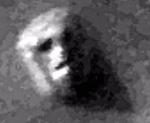 The Face on Mars
22.07.1995
This image, showing what looks to be a human face sculpted on the martian surface, was produced using data from NASA's Viking 1 orbiter in 1976. Described in a press release...
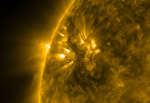 Dark Filament of the Sun
22.05.2010
Suspended by magnetic fields above a solar active region this dark filament stretches over 40 earth-diameters. The ominous structure appears to be frozen in time near the Sun's edge, but solar filaments are unstable and often erupt.
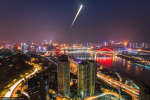 Eclipse at Moonrise
11.10.2014
As the Moon rose and the Sun set on October 8, a lunar eclipse was in progress seen from Chongqing, China. Trailing through this composite time exposure, the rising Moon began as a dark reddened disk in total eclipse near the eastern horizon.
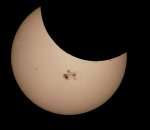 Sunspots and Solar Eclipse
25.10.2014
A New Moon joined giant sunspot group AR 2192 to dim the bright solar disk during Thursday's much anticipated partial solar eclipse. Visible from much of North America, the Moon's broad silhouette is captured in this extreme telephoto snapshot near eclipse maximum from Santa Cruz, California.
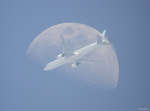 An Airplane in Front of the Moon
3.07.2018
If you look closely at the Moon, you will see a large airplane in front of it. Well, not always. OK, hardly ever. Actually, to capture an image like this takes precise timing...
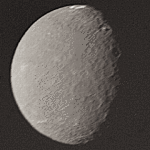 Uranus's Moon Umbriel: A Mysterious Dark World
7.04.1996
Why is Umbriel so dark? This dark moon reflects only half the light of other Uranus' moons such as Ariel. And what is that bright ring at the top? Unfortunately, nobody yet knows. These questions presented themselves when Voyager 2 passed this satellite of Uranus in January 1986.
 The Leonid Meteor Shower
16.11.1997
The Leonid Meteor Shower will likely reach its peak in the early hours this Monday morning. Though the Moon will be bright, Leo, the shower's radiant point, will be well above the eastern horizon from Western North America and the Pacific region during this period.
 Betelgeuse
19.04.1998
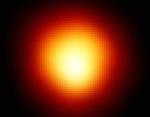
Here is the first direct picture of the surface of a star other than our Sun. Taken by the Hubble Space Telescope in 1995, the atmosphere of Betelgeuse reveals some unexpected features, including a large bright hotspot visible below the center.
|
January February March April May June July August September |
|||||||||||||||||||||||||||||||||||||||||||||||||