
|
You entered: comet
 APOD: 2023 January 4 Б CG4: The Globule and the Galaxy
4.01.2023
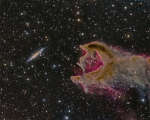
Can a gas cloud eat a galaxy? It's not even close. The "claw" of this odd looking "creature" in the featured photo is a gas cloud known as a cometary globule. This globule, however, has ruptured. Cometary globules are typically characterized by dusty heads and elongated tails.
 CG4: A Ruptured Cometary Globule
14.03.2006
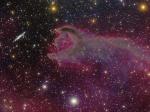
Can a gas cloud eat a galaxy? It's not even close. The odd looking "creature" in the center of the above photo is a gas cloud known as a cometary globule. This globule, however, has ruptured. Cometary globules are typically characterized by dusty heads and elongated tails.
 Camelopardalids and ISS
25.05.2014
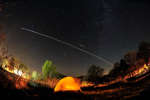
From a camp on the northern shores of the Great Lake Erie, three short bright meteor streaks were captured in this composited night skyscape. Recorded over the early morning hours of May 24, the meteors are illusive Camelopardalids.
 Shadow at the Lunar South Pole
28.11.1995
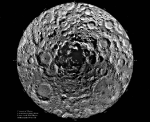
In 1994, the space probe Clementine spent 70 days in lunar orbit mapping the Moon's surface. Shown above is a dramatically detailed composite view centered on the Moon's South Pole constructed from 1500 Clementine images.
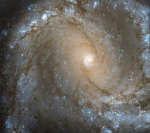 In the Center of Spiral Galaxy M61
20.05.2014
M61 is a barred spiral galaxy located in the nearby Virgo Cluster of Galaxies. Visible in M61 are a host of features common to spiral galaxies: bright spiral arms, a central bar, dust lanes, and bright knots of stars. M61, also known as NGC 4303, in similar to our own Milky Way Galaxy.
 Leonids 1998: A Safe Meteor Storm
16.11.1998
You're in no danger. During the meteor storm occurring tonight and tomorrow, thousands of bits of ice and rock will likely rain onto the Earth. Few, if any, will hit the ground. Touted as potentially the most active meteor shower since 1966, the Leonids of 1998 will be tracked by observers the world over.
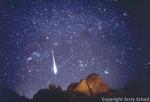 A Meteor Over the Anza Borrego Desert
11.08.1999
Meteors will be flashing across your skies over the next two nights. Specifically, the Perseid Meteor Shower should be at its best just before each morning's dawn. Observers at dark locations might see as much as a meteor a minute.
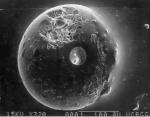 A Spherule from Outer Space
12.01.2003
When a meteorite strikes the Moon, the energy of the impact melts some of the splattering rock, a fraction of which might cool into tiny glass beads. Many of these glass beads were present in lunar soil samples returned to Earth by the Apollo missions.
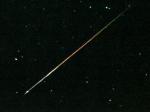 Rainbow Perseid
16.08.2002
While meteors do show colors, the colors aren't always seen with the unaided eye. Still, high speed color film recorded this rainbow-like trail as a meteor streaked through the early morning sky on August 13 above Sedona, Arizona, USA.
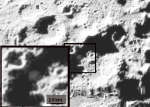 Water Discovered in Moon Shadow
18.11.2009
Why is there water on the Moon? Last month, the LCROSS mission crashed a large impactor into a permanently shadowed crater near the Moon's South Pole. A plume of dust rose that was visible to the satellite, although hard to discern from Earth. The plume is shown above in visible light.
|
January February March April May June July August September |
|||||||||||||||||||||||||||||||||||||||||||||||||