
|
You entered: comet
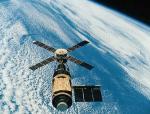 Skylab Over Earth
28.05.2000
Skylab was an orbiting laboratory launched by a Saturn V rocket in May 1973. Skylab was visited three times by NASA astronauts who sometimes stayed as long as two and a half months. Many scientific tests were performed on Skylab, including astronomical observations in ultraviolet and X-ray light.
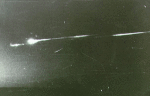 A Meteoric View of Apollo 13
9.07.1995
Meteors, also called shooting stars, normally begin as bits of dust from the tails of comets or even small pieces chipped off asteroids. Falling toward Earth, these particles enter the atmosphere at extremely high speeds. Friction with the air heats them up and makes them glow brightly.
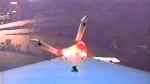 The Launch of STARDUST
5.04.1999
NASA launches powerful rockets. One such rocket, the Delta II, recently lofted the STARDUST mission into the nearby Solar System. STARDUST is expected to photograph Comet Wild in 2004 as it zooms by, and return interstellar dust samples to Earth in 2006.
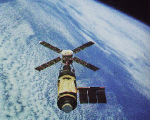 Skylab Over Earth
30.08.1995
Skylab was an orbiting laboratory launched by a Saturn V rocket in May 1973. Skylab was visited three times by NASA astronauts who sometimes stayed as long as two and a half months. Many scientific tests were preformed on Skylab, including astronomical observations in ultraviolet and X-ray light.
 CG4: A Ruptured Cometary Globule
13.10.2002
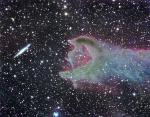
The odd looking "creature" to the right of center in the above photo is a gas cloud known as a cometary globule. This globule, however, has ruptured. Cometary globules are typically characterized by dusty heads and elongated tails.
 Skylab Over Earth
18.08.2013
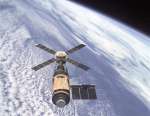
Skylab was an orbiting laboratory launched by a Saturn V rocket in May 1973. Skylab, pictured above, was visited three times by NASA astronauts who sometimes stayed as long as two and a half months. Many scientific tests were performed on Skylab, including astronomical observations in ultraviolet and X-ray light.
 Mars and Meteor over Jade Dragon Snow Mountain
20.11.2020
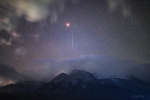
A brilliant yellowish celestial beacon, Mars still dazzles in the night. Peering between clouds the wandering planet was briefly joined by the flash of a meteor in this moonless dark sky on November 18. The single exposure was taken as the Earth swept up dust from periodic comet Tempel-Tuttle during the annual Leonid Meteor Shower.
 Zodiacal Light
26.08.1997
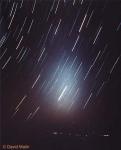
Sometimes the sky itself seems to glow. Usually, this means you are seeing a cloud reflecting sunlight or moonlight. If the glow appears as a faint band of light running across the whole sky, you are probably seeing the combined light from the billions of stars that compose our Milky Way Galaxy.
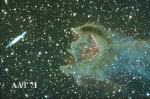 CG4: A Ruptured Cometary Globule
5.12.1998
The odd looking "creature" to the right of center in the above photo is a gas cloud known as a cometary globule. This globule, however, has ruptured. Cometary globules are typically characterized by dusty heads and elongated tails.
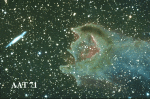 CG4: A Ruptured Cometary Globule
27.12.1996
The odd looking "creature" to the right of center in the above photo is a gas cloud known as a cometary globule. This globule, however, has ruptured. Cometary globules are typically characterized by dusty heads and elongated tails.
|
January February March April May June July August September |
|||||||||||||||||||||||||||||||||||||||||||||||||