
|
You entered: comet
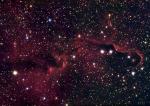 The Elephant s Trunk in IC 1396
20.07.2001
Like a picture from a galactic Just So Story, the Elephant's Trunk Nebula winds through the emission nebula and young star cluster complex IC 1396, in the high and far off constellation of Cepheus. Bright swept-back ridges compose the suggestive form, outlining pockets of interstellar dust and gas.
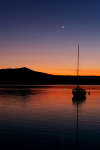 Conjunction at Sunset
29.12.2011
While Comet Lovejoy entertained early morning risers in in the southern hemisphere, a lovely conjunction of a young crescent Moon and Venus graced western skies at sunset. Captured on December 26th the conjunction, with beautiful sunset colors above and below, is seen here over Viverone Lake near Turin, Italy.
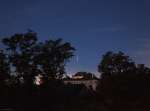 Perseid over Albrechtsberg Castle
25.08.2012
Medieval Albrechtsberg castle is nestled in trees near the northern bank of the river Pielach and the town of Melk, Austria. In clearing night skies on August 12 it stood under constellations of the northern summer, including Aquarius, Aquila, and faint, compact Delphinus (above and right of center) in this west-looking skyview.
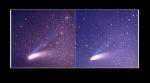 Hale-Bopp in Stereo
4.04.1997
This stereo pair of Hale-Bopp images combines two pictures from slightly different viewing angles. Simulating stereo vision, the difference was generated by the comet's apparent motion as it cruised through the inner Solar System.
 Bright Meteor, Dark Sky
20.08.1997
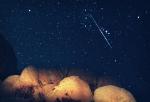
Has Orion the Hunter acquired a new weapon? If you turn your head sideways (counterclockwise) you might notice the familiar constellation of Orion, particularly the three consecutive bright stars that make up Orion's belt.
 CG4: A Ruptured Cometary Globule
13.05.2014
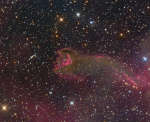
Can a gas cloud grab a galaxy? It's not even close. The "claw" of this odd looking "creature" in the above photo is a gas cloud known as a cometary globule. This globule, however, has ruptured. Cometary globules are typically characterized by dusty heads and elongated tails.
 A Southern Sky View
26.02.1998
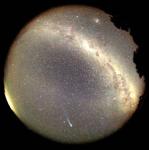
From horizon to horizon, the night sky above Loomberah, New South Wales, Australia was photographed by astronomer Gordon Garradd on March 22, 1996. Garradd used a home made all-sky camera with a fish-eye lens, resulting in a circular 200 degree field of view.
 Help Aldebaran Map the Moon
28.07.1997
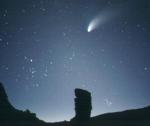
Turn on your camcorder, go outside, and become an astronomer. How?. Tomorrow morning, our Moon will pass directly in front of Aldebaran, the brightest star in this picture and in entire constellation of Taurus.
 Impact on Europa
15.08.1997
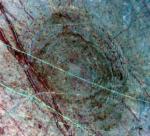
This bull's-eye pattern marks the impact of a mountain-sized comet or asteroid on the icy surface of Jupiter's moon Europa. Recorded by the Galileo spacecraft in April of this year, the composite false color image clearly reveals the telltale concentric fractures which cover about
 CG4: A Ruptured Cometary Globule
6.08.2007
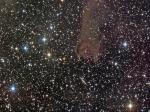
Can a gas cloud eat a galaxy? It's not even close. The odd looking "creature" or "hand" extending down from the top of the above photo is a gas cloud known as a cometary globule. This globule, however, has ruptured. Cometary globules are typically characterized by dusty heads and elongated tails.
|
January February March April May June July August September |
|||||||||||||||||||||||||||||||||||||||||||||||||