
|
You entered: surface
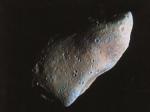 Asteroid Gaspra's Best Face
12.07.1998
Asteroid 951 Gaspra is a huge rock tumbling in space. Gaspra became one of the best-studied asteroids in 1991 when the spacecraft Galileo flew by. In the above photograph, subtle color variations have been exaggerated to highlight changes in reflectivity, surface structure and composition.
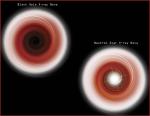 Black Holes Are Black
19.01.2001
Q: Why are black holes black? A: Because they have an event horizon. The event horizon is that one-way boundary predicted by general relativity beyond which nothing, not even light, can return. X-ray astronomers...
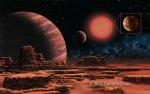 Gliese 876 System Includes Large Terrestrial Planet
14.06.2005
Is our Earth unique? In continuing efforts to answer this question, astronomers have now discovered an Earth-like planet orbiting a distant normal star. Previously over 150 gas-giant planets like Jupiter had been so discovered.
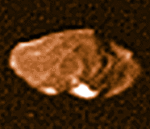 Jupiter's Moon Amalthea
3.11.1995
Amalthea is Jupiter's fifth largest moon, much smaller than the four Galilean satellites Io, Europa, Ganymede, and Callisto. The orbit of Amalthea is inside of these moons, and with its long axis always pointing toward Jupiter. It's dark surface color is probably due to sulfur being expelled from Io.
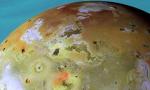 Sizzling Io
6.07.1998
What's cooking on Io? This active moon of Jupiter is marked with volcanoes spewing lava that is now known to be hotter than any lava on Earth. Above is the highest resolution color-enhanced image yet composed of the most active surface in our Solar System. Features as small as three kilometers are visible.
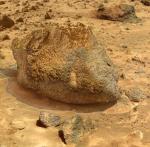 Yogi Rock on Mars
9.03.1998
Yogi is possibly the best photographed rock on Mars. By combining many pictures taken during the Mars Pathfinder Mission last year, scientists were able to create a super-resolution, digitally enhanced image that better allows them to study Yogi's surface and more accurately determine how Yogi was formed.
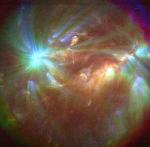 Sun Dance
11.08.1998
Hot gas dances across the surface of the Sun in this picture from the orbiting TRACE satellite. The temperature of the gas is color coded so that blue represents hundreds of thousands of Kelvin, while red represents extreme temperatures in the millions of Kelvin.
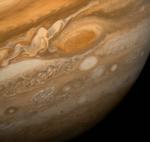 Jupiter from Voyager
18.07.1999
This picture of the planet Jupiter was taken by the Voyager 1 spacecraft as it passed the planet in 1979. Jupiter, a gas giant planet with no solid surface, is the largest planet in the Solar System and is made mostly of the hydrogen and helium.
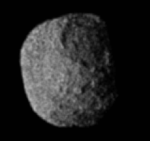 Neptune's Moon Proteus
4.11.1995
Proteus is the second largest moon of Neptune behind the mysterious Triton. Proteus was discovered only in 1982 by the Voyager 2 spacecraft. This is unusual since Neptune has a smaller moon - Nereid - which was discovered 33 years earlier from Earth.
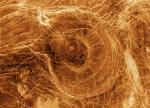 Arachnoids on Venus
20.01.1998
Arachnoids are large structures of unknown origin that have been found only on the surface of Venus. Arachnoids get their name from their resemblance to spider-webs. They appear as concentric ovals surrounded by a complex network of fractures, and can span 200 kilometers.
|
January February March April May June July August September October |
|||||||||||||||||||||||||||||||||||||||||||||||||