
|
You entered: surface
 The Holographic Principle
30.01.2005
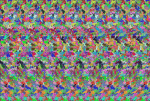
Is this image worth a thousand words? According to the Holographic Principle, the most information you can get from this image is about 3 x 10 65 bits for a normal sized computer monitor.
 The Holographic Principle
13.09.2009
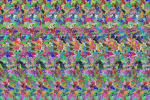
Is this picture worth a thousand words? According to the Holographic Principle, the most information you can get from this image is about 3 x 10 65 bits for a normal sized computer monitor.
 Hubbles Jupiter and the Shrinking Great Red Spot
9.01.2022
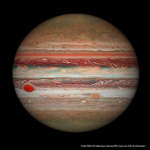
What will become of Jupiter's Great Red Spot? Gas giant Jupiter is the solar system's largest world with about 320 times the mass of planet Earth. Jupiter is home to one of the largest and longest lasting storm systems known, the Great Red Spot (GRS), visible to the left.
 MESSENGER s Last Day on Mercury
1.05.2015
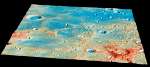
The first to orbit Mercury, the MESSENGER spacecraft came to rest on this region of Mercury's surface yesterday. Constructed from MESSENGER image and laser altimeter data, the scene looks north over the northeastern rim of the broad, lava filled Shakespeare basin.
 Coronal Inflow
29.11.2001
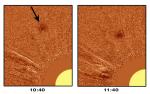
The active Sun has thrown a lot our way lately, including storms of particles streaming outward in the solar wind and clouds of plasma which triggered awesome auroral displays. Still, a growing body...
 Perseverance: Seven Minutes to Mars
16.02.2021
How hard is it to land safely on Mars? So hard that many more attempts have failed than succeeded. The next attempt will be on Thursday. The main problem is that the Martian atmosphere is too thick to ignore -- or it will melt your spacecraft.
 A Venus Flyby
25.02.2021
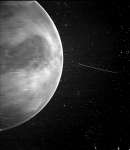
On a mission to explore the inner heliosphere and solar corona, on July 11, 2020 the Wide-field Imager on board NASA's Parker Solar Probe captured this stunning view of the nightside of Venus at distance of about 12,400 kilometers (7,693 miles).
 APOD: 2023 October 23 Б Moon Io from Spacecraft Juno
23.10.2023
There goes another one! Volcanoes on Jupiter's moon Io keep erupting. To investigate, NASA's robotic Juno spacecraft has begun a series of visits to this very strange moon. Io is about...
 MESSENGER s Last Day on Mercury
1.05.2025
The first to orbit inner planet Mercury, the MESSENGER spacecraft came to rest on this region of Mercury's surface on April 30, 2015. Constructed from MESSENGER image and laser altimeter data, the projected scene looks north over the northeastern rim of the broad, lava filled Shakespeare basin.
 Layers of a Total Solar Eclipse
27.09.2017
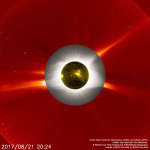
Neither rain, nor snow, nor dark of night can keep a space-based spacecraft from watching the Sun. In fact, from its vantage point 1.5 million kilometers sunward of planet Earth, NASA's SOlar Heliospheric Observatory (SOHO) can always monitor the Sun's outer atmosphere, or corona.
|
January February March April May June July August September October |
|||||||||||||||||||||||||||||||||||||||||||||||||