
|
You entered: surface
 Io at Sunset
20.01.2003
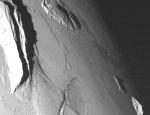
How tall are mountains on Jupiter's moon Io? One way to find out is to view them at sunset. Tall structures facing the Sun are then better-lit and cast long shadows. The above...
 Mars: A Sheer Close Up
13.11.1997
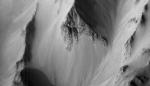
As the Mars Global Surveyor spacecraft maneuvers toward its final mapping orbit, its cameras have been producing some sharp views of Mars. At a resolution of better than 30 feet per pixel, this image...
 Mysterious Features on Ganymede
9.12.1997
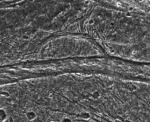
Where is the rest of the circle? Jupiter's largest moon Ganymede has some truly unusual terrain, including the pictured half circle above cut by nearly parallel curves. Full circles can be easily explained by impact craters, but partial circles imply that some resurfacing has occurred since the original impact.
 Solar Flares Cause Sun Quakes
1.06.1998
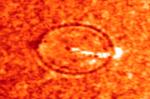
An 11th magnitude quake has been recorded on the Sun, immediately following a moderate solar flare. The quake was the first ever recorded on the Sun, but only because astronomers have only recently figured out when and how to find them using the orbiting SOHO spacecraft.
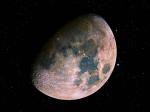 Colorful Moon Mosaic
7.09.2006
No single exposure can easily capture faint stars along with the subtle colors of the Moon. But this dramatic composite view highlights both. The mosaic digitally stitches together fifteen carefully exposed high resolution images of a bright, gibbous Moon and a representative background star field.
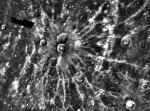 Degas Ray Crater on Mercury
8.12.1996
Like the Earth's Moon, Mercury is scarred with craters, testifying to an intense bombardment during the early history of the Solar System. In 1974, the Mariner 10 spacecraft surveyed this innermost planet up close, producing the only detailed images of its tortured surface.
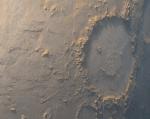 Happy Face Crater on Mars
15.03.1999
Even Mars can put on a happy face. The Martian crater Galle has internal markings reminiscent of a smiley face symbol. Such markings were originally discovered in the late 1970s in pictures taken by the Viking Orbiter. A large meteor impacted the Martian surface to form the crater.
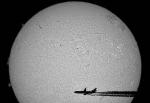 An Airplane in Front of the Sun
29.01.2001
Sometimes, good planes come to those who wait. Experienced solar photographer Thierry Lagault had noticed planes crossing in front of the Sun from his home in suburban Paris. He then got the idea for the above photograph, but had to wait through many near misses.
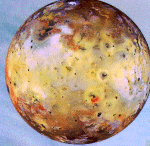 Io Full Face
29.10.1996
Io is a colorful place. The closest large moon of Jupiter, Io is the most volcanic moon in the Solar System with its surface being completely buried in volcanic lava every few thousand years.
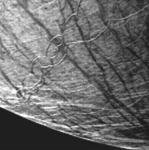 Ice Cusps on Europa
9.06.1998
Europa's icy crust has many unusual features. Pictured above is part of Europa's southern hemisphere photographed by the Galileo spacecraft currently orbiting Jupiter. Europa is one of the largest moons of Jupiter, and is thought to have oceans of water underneath its ice-covered surface.
|
January February March April May June July August September October |
|||||||||||||||||||||||||||||||||||||||||||||||||