
|
You entered: nearby
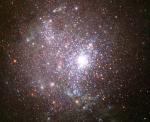 The Stars of NGC 1705
23.04.2003
Some 2,000 light-years across, NGC 1705 is small as galaxies go, similar to our Milky Way's own satellite galaxies, the Magellanic Clouds. At a much larger distance of 17 million light-years...
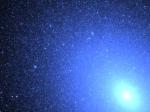 M32: Blue Stars in an Elliptical Galaxy
3.11.1999
Elliptical galaxies are known for their old, red stars. But is this old elliptical up to new tricks? In recent years, the centers of elliptical galaxies have been found to emit unexpectedly high amounts of blue and ultraviolet light.
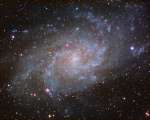 M33: Triangulum Galaxy
30.11.2017
The small, northern constellation Triangulum harbors this magnificent face-on spiral galaxy, M33. Its popular names include the Pinwheel Galaxy or just the Triangulum Galaxy. M33 is over 50,000 light-years in diameter, third largest in the Local Group of galaxies after the Andromeda Galaxy (M31), and our own Milky Way.
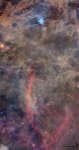 From the Pleiades to the Eridanus Loop
23.03.2020
If you stare at an interesting patch of sky long enough, will it look different? In the case of Pleiades and Hyades star clusters -- and surrounding regions -- the answer is: yes, pretty different. Long...
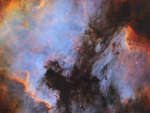 North America and the Pelican
16.09.2021
Fans of our fair planet might recognize the outlines of these cosmic clouds. On the left, bright emission outlined by dark, obscuring dust lanes seems to trace a continental shape, lending the popular name North America Nebula to the emission region cataloged as NGC 7000.
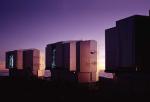 The VLT Interferometric Array
9.03.1999
The Very Large Telescope (VLT) Interferometric Array will be able to act as individual telescopes or as one huge telescope. Of the four planned VLTs in Chile, two have now reached completion. The first VLT to operate is visible on the left of the above photograph and was recently given the name Antu.
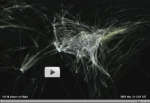 Airplane Flight Patterns over the USA
29.04.2008
What are these Earthlings going? Millions of people move about planet Earth by airplane every day. Hundreds of thousands of airplane flights take place over the US every day. A dramatic graphical depiction of these flights was created by Aaron Koblin and is shown above.
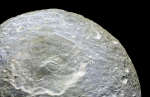 Herschel Crater on Mimas of Saturn
11.05.2010
Why is this giant crater on Mimas oddly colored? Mimas, one of the smaller round moons of Saturn, sports Herschel crater, one of the larger impact craters in the entire Solar System. The robotic...
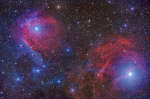 Scorpius in Red and Blue
25.05.2012
Cosmic dust clouds dim the light of background stars. But they also reflect the light of stars nearby. Since bright stars tend to radiate strongly in the blue portion of the visible spectrum, and the interstellar dust scatters blue light more strongly than red, the dusty reflection nebulae tend to be blue.
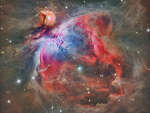 M42: Inside the Orion Nebula
20.03.2013
The Great Nebula in Orion, an immense, nearby starbirth region, is probably the most famous of all astronomical nebulas. Here, glowing gas surrounds hot young stars at the edge of an immense interstellar molecular cloud only 1500 light-years away.
|
January February March April May |
|||||||||||||||||||||||||||||||||||||||||||||||||