
|
You entered: nearby
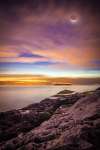 Moon, Venus, and Planet Earth
19.09.2013
In this engaging scene from planet Earth, the Moon shines through cloudy skies following sunset on the evening of September 8. Despite the fading light, the camera's long exposure still recorded a colorful, detailed view of a shoreline and western horizon looking toward the island San Gabriel from Colonia del Sacramento, Uruguay.
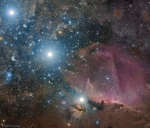 Orion: Belt, Flame, and Horsehead
4.06.2017
What surrounds the famous belt stars of Orion? A deep exposure shows everything from dark nebula to star clusters, all embedded in an extended patch of gaseous wisps in the greater Orion Molecular Cloud Complex.
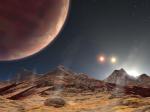 HD 188753: Triple Sunset
5.08.2005
Although it looks like fiction, this artist's vision of sunset on an alien world is based on fact -- the recent discovery of a hot, jupiter-sized planet orbiting in triple star system HD 188753.
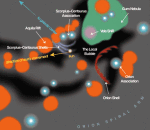 The Local Bubble and the Galactic Neighborhood
12.04.2000
What surrounds the Sun in this neck of the Milky Way Galaxy? Our current best guess is depicted in the above map of the surrounding 1500 light years constructed from various observations and deductions.
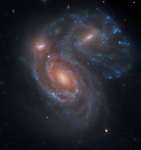 Arp 272
22.09.2011
Linking spiral arms, two large colliding galaxies are featured in this remarkable cosmic portrait constructed using image data from the Hubble Legacy Archive. Recorded in astronomer Halton Arp's Atlas of Peculiar Galaxies as Arp 272, the pair is otherwise known as NGC 6050 near center, and IC 1179 at upper right.
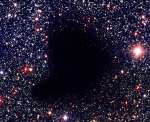 Molecular Cloud Barnard 68
29.01.2012
Where did all the stars go? What used to be considered a hole in the sky is now known to astronomers as a dark molecular cloud. Here, a high concentration of dust and molecular gas absorb practically all the visible light emitted from background stars.
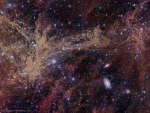 The M81 Galaxy Group through the Integrated Flux Nebula
27.06.2017
Distant galaxies and nearby nebulas highlight this deep image of the M81 Group of galaxies. First and foremost in this 80-exposure mosaic is the grand design spiral galaxy M81, the largest galaxy in the image, visible on the lower right.
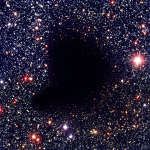 Dark Molecular Cloud Barnard 68
8.10.2017
Where did all the stars go? What used to be considered a hole in the sky is now known to astronomers as a dark molecular cloud. Here, a high concentration of dust and molecular gas absorb practically all the visible light emitted from background stars.
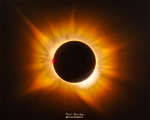 APOD: 2026 August 17 Б A Golden Corona Eclipse
17.08.2026
This total solar eclipse appeared not only poetically beautiful but scientifically interesting. Usually the solar corona appears white, and to some observers the corona of last week's total solar eclipse did appear this pearly color. But this time, totality observers in Spain saw a corona that appeared unusually golden.
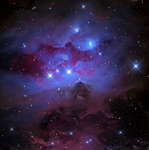 Reflections on the 1970s
18.12.2014
The 1970s are sometimes ignored by astronomers, like this beautiful grouping of reflection nebulae in Orion - NGC 1977, NGC 1975, and NGC 1973 - usually overlooked in favor of the substantial glow from the nearby stellar nursery better known as the Orion Nebula.
|
January February March April May June July August September |
|||||||||||||||||||||||||||||||||||||||||||||||||