
|
You entered: nearby
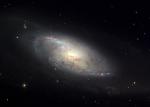 M106 in Canes Venatici
30.07.2005
Close to the Great Bear (Ursa Major) and surrounded by the stars of the Hunting Dogs (Canes Venatici), this celestial nebula was discovered in 1781 by the metric French astronomer Pierre Mechain. Later, it was added to the catalog of his friend and colleague Charles Messier as M106.
 Methane Dwarf
3.06.1999
While hunting through Sloan Sky Survey data in search of distant quasars, Princeton astronomers Xiaohui Fan and Michael Strauss came upon an undiscovered type of object very nearby - now dubbed a methane dwarf. Marked...
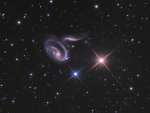 Arp 273
14.11.2008
The two prominent stars in the foreground of this colorful skyscape are well within our own Milky Way Galaxy. Their spiky appearance is due to diffraction in the astronomer's telescope. But the two eye-catching galaxies in view lie far beyond the Milky Way, at a distance of about 200 million light-years.
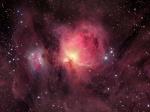 M42: Wisps of the Orion Nebula
18.09.2005
The Great Nebula in Orion, an immense, nearby starbirth region, is probably the most famous of all astronomical nebulas. Here, glowing gas surrounds hot young stars at the edge of an immense interstellar molecular cloud only 1500 light-years away. In the above deep image, faint wisps and sheets of dust and gas are particularly evident.
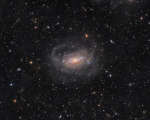 Curly Spiral Galaxy M63
3.12.2020
A bright spiral galaxy of the northern sky, Messier 63 is nearby, about 30 million light-years distant toward the loyal constellation Canes Venatici. Also cataloged as NGC 5055, the majestic island universe is nearly 100,000 light-years across, about the size of our own Milky Way.
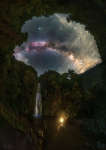 A Waterfall and the Milky Way
31.10.2021
The dream was to capture both the waterfall and the Milky Way together. Difficulties included finding a good camera location, artificially illuminating the waterfall and the surrounding valley effectively, capturing the entire scene with...
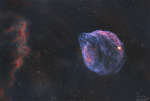 APOD: 2023 March 29 Б Sh2-308: A Dolphin Shaped Star Bubble
28.03.2023
Which star created this bubble? It wasn't the bright star on the bubble's right. And it also wasn't a giant space dolphin. It was the star in the blue nebula's center, a famously energetic Wolf-Rayet star.
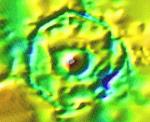 Mjølnir: Impact Crater
10.06.1999
The stark surface of Earth's moon is pocked with large craters, records of a history of fierce bombardment by the solar system's formative debris. It may be difficult to imagine, but nearby planet Earth itself has endured a similar cosmic pounding, though oceans, weathering, and geological
 NGC 253 Close Up
2.10.2008
This dusty island universe is one of the brightest spiral galaxies in the sky. Seen nearly edge-on, NGC 253 lies a mere 13 million light-years away and is the largest member of the Sculptor Group of galaxies, neighbor to our own local galaxy group.
 Red Snow Moon over Edmonton
27.02.2011
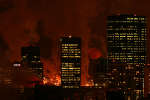
What's hovering between those buildings? The Moon. The above image was taken two weeks ago as the full Snow Moon started to rise above Edmonton, Alberta, Canada. The odd coincidence between the angular size of the far distant Moon and the angular width of nearby buildings created a striking juxtaposition.
|
January February March April May |
|||||||||||||||||||||||||||||||||||||||||||||||||