
|
You entered: universe
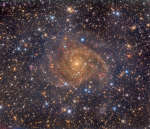 Hidden Galaxy IC 342
29.01.2016
Similar in size to large, bright spiral galaxies in our neighborhood, IC 342 is a mere 10 million light-years distant in the long-necked, northern constellation Camelopardalis. A sprawling island universe, IC 342 would otherwise...
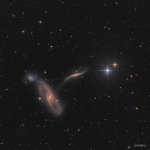 Arp 286: Trio in Virgo
10.06.2022
This colorful telescopic field of view features a trio of interacting galaxies almost 90 million light-years away, toward the constellation Virgo. On the right two spiky, foreground Milky Way stars echo the extragalactic hues, a reminder that stars in our own galaxy are like those in distant island universes.
 Spiral Galaxy NGC 6744
1.11.2024
Big, beautiful spiral galaxy NGC 6744 is nearly 175,000 light-years across, larger than our own Milky Way. It lies some 30 million light-years distant in the southern constellation Pavo but appears as only a faint smudge in the eyepiece of a small telescope.
 APOD: 2025 April 15 Б Planetary Nebula NGC 1514 from Webb
15.04.2025
What happens when a star runs out of nuclear fuel? For stars like our Sun, the center condenses into a white dwarf while the outer atmosphere is expelled into space to appear as a planetary nebula.
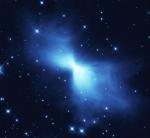 Cold Wind from the Boomerang Nebula
20.02.2003
A cold wind blows from the central star of the Boomerang Nebula. Seen here in a detailed false-color image recorded in 1998 by the Hubble Space Telescope, the nebula lies about 5,000 light-years away towards the grand southern constellation of Centaurus.
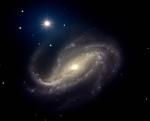 NGC 613: Spiral of Dust and Stars
1.10.2005
When morning twilight came to the Paranal Observatory in Chile, astronomers Mark Neeser and Peter Barthel interrupted their search for faint quasars, billions of light-years away. And just for a moment, they used Very Large Telescopes at the European Southern Observatory to appreciate the beauty of the nearby Universe.
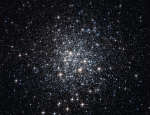 M72: A Globular Cluster of Stars
19.08.2012
Globular clusters once ruled the Milky Way. Back in the old days, back when our Galaxy first formed, perhaps thousands of globular clusters roamed our Galaxy. Today, there are less than 200 left. Many globular clusters were destroyed over the eons by repeated fateful encounters with each other or the Galactic center.
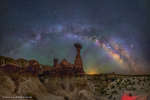 The Milky Way Over the Arizona Toadstools
22.02.2015
Which is older -- the rocks you see on the ground or the light you see from the sky? Usually its the rocks that are older, with their origin sentiments deposited well before light left any of the stars or nebulas you see in the sky.
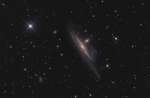 Galaxies in the River
10.02.2016
Large galaxies grow by eating small ones. Even our own galaxy practices galactic cannibalism, absorbing small galaxies that get too close and are captured by the Milky Way's gravity. In fact, the practice...
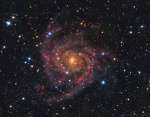 IC 342: The Hidden Galaxy
16.01.2019
Similar in size to large, bright spiral galaxies in our neighborhood, IC 342 is a mere 10 million light-years distant in the long-necked, northern constellation Camelopardalis. A sprawling island universe, IC 342 would otherwise...
|
January February March April May |
|||||||||||||||||||||||||||||||||||||||||||||||||