
|
You entered: universe
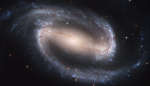 Barred Spiral Galaxy NGC 1300
8.01.2016
Big, beautiful, barred spiral galaxy NGC 1300 lies some 70 million light-years away on the banks of the constellation Eridanus. This Hubble Space Telescope composite view of the gorgeous island universe is one of the largest Hubble images ever made of a complete galaxy.
 IC 2574: Coddington's Nebula
5.02.2025
Grand spiral galaxies often seem to get all the glory, flaunting their young, bright, blue star clusters in beautiful, symmetric spiral arms. But small, irregular galaxies form stars too. In fact dwarf galaxy IC 2574 shows clear evidence of intense star forming activity in its telltale reddish regions of glowing hydrogen gas.
 APOD: 2025 May 9 Б IXPE Explores a Black Hole Jet
8.05.2025
How do black holes create X-rays? Answering this long-standing question was significantly advanced recently with data taken by NASAБs IXPE satellite. X-rays cannot exit a black hole, but they can be created in the energetic environment nearby, in particular by a jet of particles moving outward.
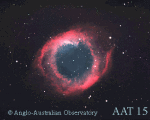 NGC 7293: The Helix Nebula
17.04.1996
The Helix nebula (New General Catalog number 7293) is estimated to be a mere 450 light-years from the Sun, in the direction of the constellation Aquarius. At that distance it may well be the closest planetary nebula, offering a dramatic snapshot of a brief final evolutionary stage in the life of a solar-type star.
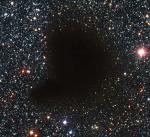 Molecular Cloud Barnard 68
11.05.1999
Where did all the stars go? What used to be considered a hole in the sky is now known to astronomers as a dark molecular cloud. Here, a high concentration of dust and molecular gas absorb practically all the visible light emitted from background stars.
 NGC 7331 and Beyond
13.09.2023
Big, beautiful spiral galaxy NGC 7331 is often touted as an analog to our own Milky Way. About 50 million light-years distant in the northern constellation Pegasus, NGC 7331 was recognized early on as a spiral nebula and is actually one of the brighter galaxies not included in Charles Messier's famous 18th century catalog.
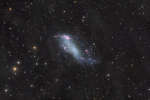 IC 2574: Coddington s Nebula
18.02.2026
Grand spiral galaxies often seem to get all the glory, flaunting their young, bright, blue star clusters in beautiful, symmetric spiral arms. But small, irregular galaxies form stars too. In fact, dwarf galaxy IC 2574 shows clear evidence of intense star forming activity in its telltale reddish regions of glowing hydrogen gas.
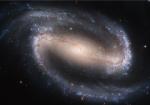 Barred Spiral Galaxy NGC 1300
11.01.2005
Big, beautiful barred spiral galaxy NGC 1300 lies some 70 million light-years away on the banks of the constellation Eridanus. This Hubble Space Telescope composite view of the gorgeous island universe was released...
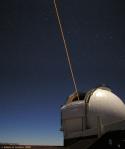 A Telescope Laser Creates an Artificial Star
6.02.2005
What do you get when you combine one of the world's most powerful telescopes with a powerful laser? An artificial star. Monitoring fluctuations in brightness of a genuine bright star can indicate how the Earth's atmosphere is changing, but many times no bright star exists in the direction where atmospheric information is needed.
 A Cliff Looming on Comet 67P
19.05.2015
What that looming behind this gravel-strewn hill on Comet ChuryumovGerasimenko? A jagged cliff. The unusual double-lobed nucleus of Comet 67P/ChuryumovGerasimenko lends itself to unusual and dramatic vistas, another of which has been captured by the Rosetta spacecraft that arrived at the comet last September.
|
January February March April May June July August |
||||||||||||||||||||||||||||||||||||||||||||||||||||||||