
|
You entered: comet
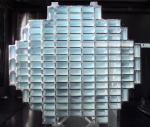 Aerogel For Stardust
18.02.1999
On February 7th, this honey comb of aluminum cells filled with aerogel was launched on the STARDUST mission to interplanetary space. STARDUST's goal is to capture dust from a comet's tail and return to planet Earth - the first sample return mission to a comet!
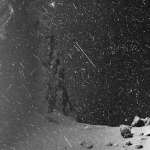 The Snows of Churyumov Gerasimenko
26.04.2018
You couldn't really be caught in this blizzard while standing by a cliff on Churyumov-Gerasimenko, also known as comet 67P. Orbiting the comet in June of 2016 the Rosetta spacecraft's narrow angle...
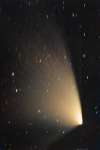 The Broad Tail of PanSTARRS
30.03.2013
For northern hemisphere skygazers, fading Comet PanSTARRS (C/2011 L4) still hangs above the western horzion, after sunset but before moonrise in the coming days. Its perspective from planet Earth continues to reveal the comet's broad dust tail.
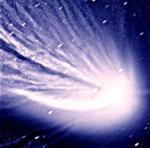 Detailing Hale-Bopp
8.05.1997
This enhanced composite image detailing structure in the coma and dust tail of Hale-Bopp was recorded May 5 - one day before the comet's passage from north to south across the plane of Earth's orbit.
 APOD: 2024 August 11 Б Animation: Perseid Meteor Shower
11.08.2024
Where do Perseid meteors come from? Mostly small bits of stony grit, Perseid meteoroids were once expelled from Comet Swift-Tuttle and continue to follow this comet's orbit as they slowly disperse. The featured animation depicts the entire meteoroid stream as it orbits our Sun.
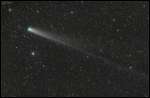 Lovejoy in the New Year
3.01.2014
A rival to vanquished Comet ISON in 2013, Comet Lovejoy (C/2013 R1) still sweeps through early morning skies, captured in this starry scene on New Year's day. The frame stretches some 3.5 degrees across a background of faint stars in the constellation Hercules.
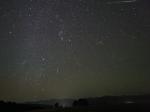 Orionid Meteors Over Turkey
23.10.2006
Meteors have been flowing out from the constellation Orion. This was expected, as mid-October is the time of year for the Orionids Meteor Shower. Pictured above, over a dozen meteors were caught in successively added exposures over three hours taken this past weekend from a town near Bursa, Turkey.
 APOD: 2025 July 17 Б 3I/ATLAS
17.07.2025
Discovered on July 1 with the NASA-funded ATLAS (Asteroid Terrestrial-impact Last Alert, System) survey telescope in Rio Hurtado, Chile, 3I/ATLAS is so designated as the third known interstellar object to pass through our Solar System It follows 1I/йOumuamua in 2017 and the comet 2I/Borisov in 2019.
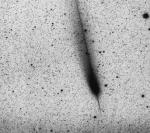 Hale Bopp: A Continuing Tail
20.02.1998
Where is Hale-Bopp now? The Great Comet of 1997, one of the largest and most active comets ever, is outbound about 400 million miles from the sun. Too faint for viewing without telescopes or binoculars, Hale-Bopp is presently positioned in the very southerly constellation of Pictor.
 Perihelion Approaches
15.08.2015
This dramatic outburst from the nucleus of Comet 67P/Churyumov-Gerasimenko occured on August 12, just hours before perihelion, its closest approach to the Sun. Completing an orbit of the Sun once every 6.45 years, perihelion distance for this periodic comet is about 1.3 astronomical units (AU), still outside the orbit of planet Earth (at 1 AU).
|
January February March April May June July August |
||||||||||||||||||||||||||||||||||||||||||||||||||||||||